
Trading success depends on more than reading charts, spotting setups, and managing risk. The way you respond to fear, frustration, greed, and overconfidence can have just as much impact on your results. This is where Emotional Control becomes important. It does not mean ignoring your feelings or trying to become emotionless. It means staying disciplined and following your trading plan even when the market puts you under pressure.

A good trader still feels fear, excitement, and frustration. The difference is that those emotions do not decide the trade.
Every trade comes with uncertainty. No matter how strong a setup looks, there is always a chance that it will fail. This uncertainty naturally creates emotional pressure. When a trade moves against you, fear may make you close too early. When a trade moves in your favor, greed may make you hold longer than planned. After a few losses, frustration may push you to take another trade too quickly just to recover the money.
The real problem is not the emotion itself. The problem starts when emotion changes your trading plan.
For example, you may normally risk 1% on a trade. After two losing trades, you may suddenly risk more because you want to recover faster. Your strategy may be the same, but your emotional state has changed your behavior.
Over time, these small changes can make trading results inconsistent.
Emotional control helps traders follow the same process whether the previous trade was a win or a loss. That consistency is important because one emotional decision can easily lead to another.
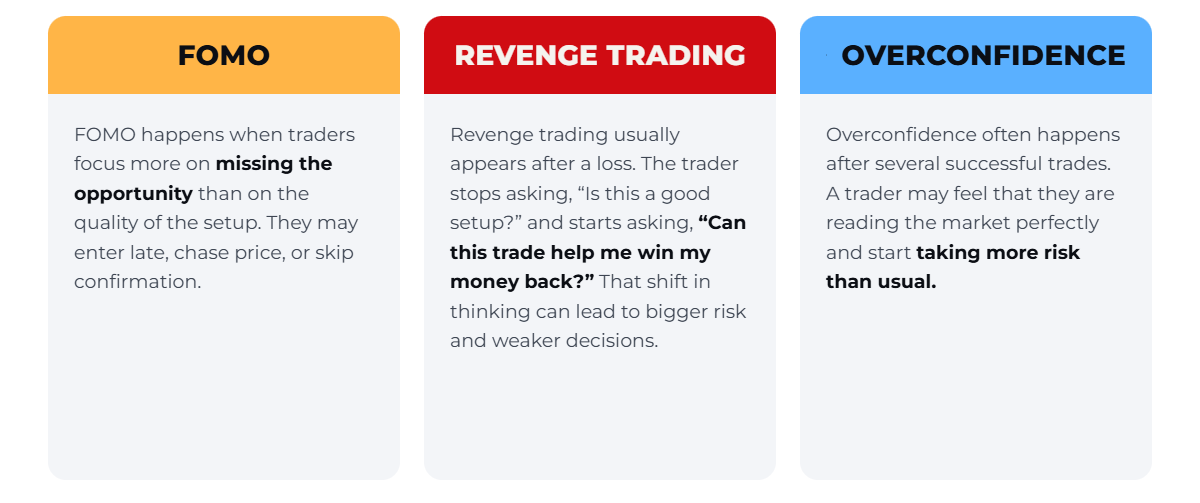
Emotions can influence traders before, during, and after a trade. Before entering a position, FOMO and impatience are common problems. A trader may see the market moving quickly and feel that they need to enter right away. Instead of waiting for confirmation, they chase the move because they are afraid of missing the opportunity.
This often leads to poor entries, weak risk-to-reward, and trades that do not follow the original plan.
Emotions can become even stronger once money is at risk. A trader may take profit too early because they are afraid the price will reverse. Another trader may keep holding a losing trade because they do not want to accept the loss.
At this point, they may start moving stop losses, changing targets, adding to losing positions, or ignoring the original setup. The same problem can continue after a trade ends. A loss may lead to revenge trading. A trader feels frustrated and immediately enters another position to make the money back. A winning streak can also be dangerous because confidence may turn into overconfidence.
After several wins, traders may increase position size too quickly, take weaker setups, or trade more often than usual. Both winning and losing streaks can affect judgment.
Some emotional mistakes are easy to notice. Others are harder because they can feel reasonable at the time.
Another common problem is focusing too much on P&L. When traders constantly watch the dollar amount going up and down, they may start making decisions based on money instead of the setup.
A trader may refuse to close a losing position because they do not want to accept a $500 loss. Another may close a good trade too early because they are afraid a $300 profit will disappear.
There is also outcome bias. This is when traders judge a decision only by whether it made or lost money. A bad trade can still make money. A good trade can still lose. That is why a better question is not only, “Did I make money?” but also, “Did I follow my plan?”
Emotional control becomes easier when traders use clear rules instead of trying to rely on willpower alone. A simple system can help reduce impulsive decisions and make it easier to stay disciplined when the market becomes stressful.
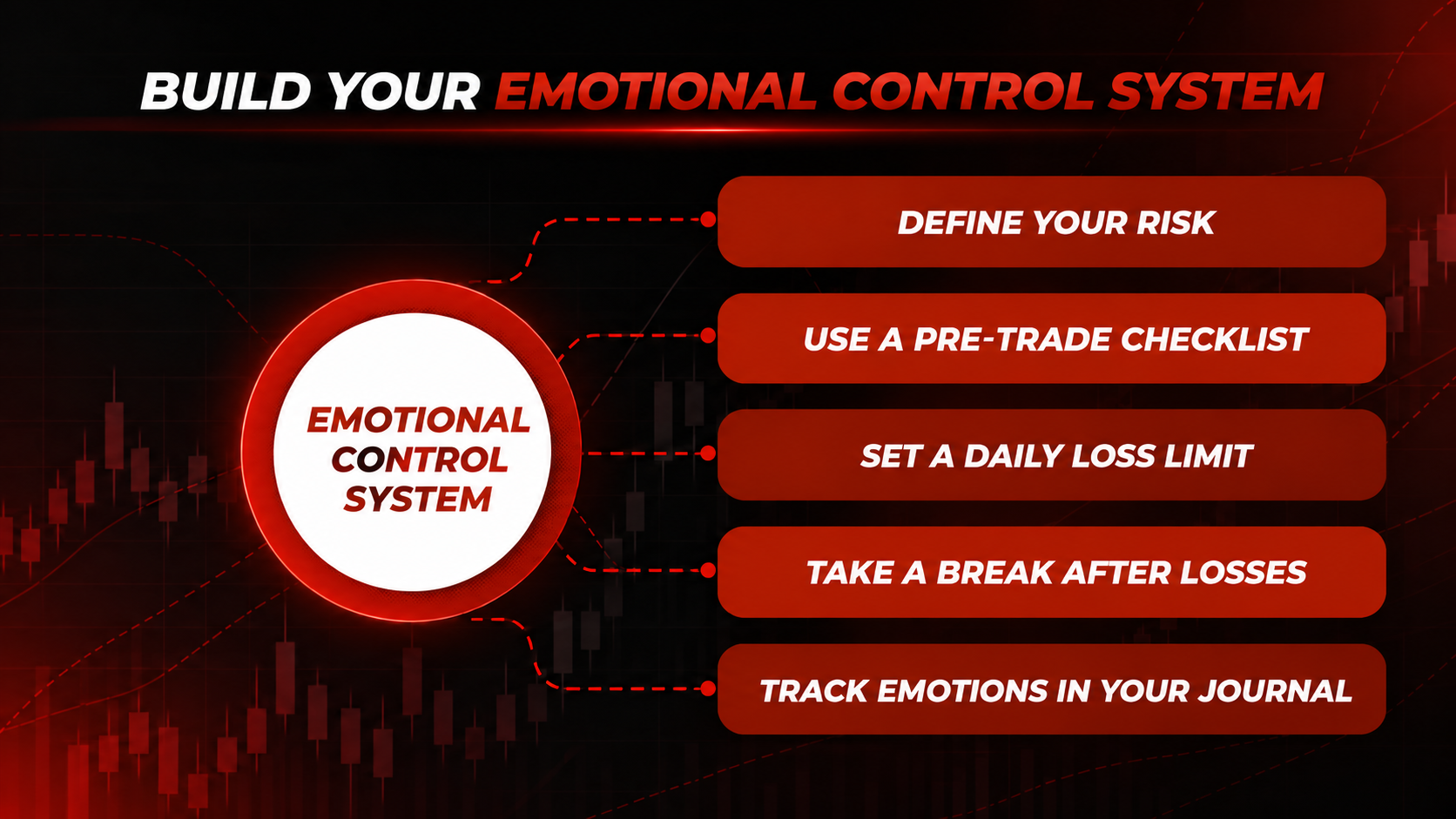
The goal is to make important decisions before emotions become strong. By defining risk, using a checklist, setting clear limits, taking breaks when needed, and reviewing emotional patterns, traders can create a more consistent decision-making process.
These steps do not remove emotions from trading. They simply reduce the chance that fear, frustration, or overconfidence will control the next trade.
Warren Buffett is often used as an example of strong emotional discipline in financial markets. Rather than reacting to every short-term market move, he focuses on the value of the business and the quality of the investment.
During periods of market panic, many investors make decisions based on fear. They sell because prices are falling, even when the long-term fundamentals of the business have not changed. Buffett has often taken the opposite approach: instead of following the crowd, he stays focused on his investment principles and looks for opportunities when others are acting emotionally.
The 2008 financial crisis is a good example. While fear was spreading across the market, Buffett continued to make major investments rather than simply reacting to the panic around him. His decisions were based on analysis, risk, and long-term value rather than short-term emotion.
The lesson for traders is not that they should copy Buffett’s investment style. The lesson is that emotional discipline starts with having clear rules and trusting your process. Fear, excitement, and uncertainty will always be part of the market, but they should not be the main reason behind a decision.
This is what emotional control is really about: not removing emotion, but preventing emotion from taking control of your strategy.
Trading will always involve emotion because it involves uncertainty, risk, and real money.
You cannot completely remove fear, greed, frustration, or excitement. Trying to become emotionless is not realistic. A better goal is to build a trading system that still works when emotions appear.
Define your risk before entering. Follow clear rules. Take breaks when needed. Track your emotional patterns. Most importantly, judge your trading by the quality of your process, not only by the money you made or lost. Consistent trading does not mean making perfect decisions every time. It means having enough structure that one emotional moment does not control the next trade.
Mastering your emotions is just as important as mastering your strategy—join the Dorian Trader Club to build stronger discipline, make more consistent decisions, and trade with greater confidence.
1. Lorem ipsum dolor sit amet, consectetur adipiscing elit. Ut elit tellus, luctus nec ullamcorper mattis, pulvinar dapibus leo.