
Retirement often changes the way you approach your finances. While your working years may focus on growing your savings and building your investment portfolio, retirement brings a new priority: generating consistent income while managing risk and protecting the wealth you have accumulated. For investors looking for ways to put their portfolios to work, options trading for retirement may offer strategies to generate additional income while maintaining a thoughtful approach to risk management.

That is where options trading sometimes enters the conversation. Some retirees and investors approaching retirement look at options as another way to generate income from stocks or cash they already own. Strategies such as covered calls, cash-secured puts, and certain spreads can bring in option premium, while other strategies can be used to help manage risk. But that does not mean options trading is automatically safe, and it certainly does not mean it can produce the same amount of income every month.
So, can retirees use options trading as a safe way to generate income? The better answer is that options can be used as part of a retirement plan, but only when the trader understands the strategy, the risk involved, and what can happen when a trade does not go as planned.
One reason options are attractive to retirees is simple: income. After leaving the workforce, many people no longer receive a regular paycheck. They may rely on Social Security, pensions, retirement accounts, dividends, or withdrawals from investments. For someone who already owns stocks, selling options may provide another possible source of cash flow.
For example, an investor who owns 100 shares of a stock may choose to sell a covered call. In return for giving someone else the right to buy those shares at a certain price, the investor receives an option premium. If the stock stays below the strike price, the option may expire and the investor keeps both the shares and the premium. If the stock rises above the strike price, the shares may be called away.
This can sound simple, and in some cases it is fairly straightforward, but there is always a trade-off. The investor receives premium, but they also give up some potential upside if the stock rises sharply. Options income is never free money.
Options trading can provide opportunities to generate additional income during retirement, but that income is never guaranteed. The market does not pay a fixed salary, and the results can vary from month to month depending on market conditions, trade selection, and risk management.
For retirees, the goal should not simply be to collect as much premium as possible. It is equally important to understand the risks involved and choose strategies that align with your financial goals, risk tolerance, and existing portfolio.
There are several options strategies that investors can use to pursue income while managing their investments. Three strategies worth understanding are Covered Calls, Cash-Secured Puts, and Collars. Covered Calls allow investors to collect premiums on stocks they already own. Cash-Secured Puts allow investors to collect premiums while setting aside enough cash to purchase shares if assigned. Collars combine options on an existing stock position to help limit potential losses in exchange for giving up some upside potential.
Each strategy serves a different purpose and comes with its own trade-offs. While Covered Calls and Cash-Secured Puts focus on collecting premiums, Collars are primarily used to protect an existing stock position against significant declines while retaining some potential for gains.
Understanding how these strategies work, what risks they carry, and when they may be appropriate can help retirees make more informed decisions about using options as part of a broader retirement income plan.
Covered calls are one of the first strategies many investors learn when they begin exploring options for income. The basic idea is that you already own at least 100 shares of a stock and then sell a call option against those shares. In exchange, you collect premium.
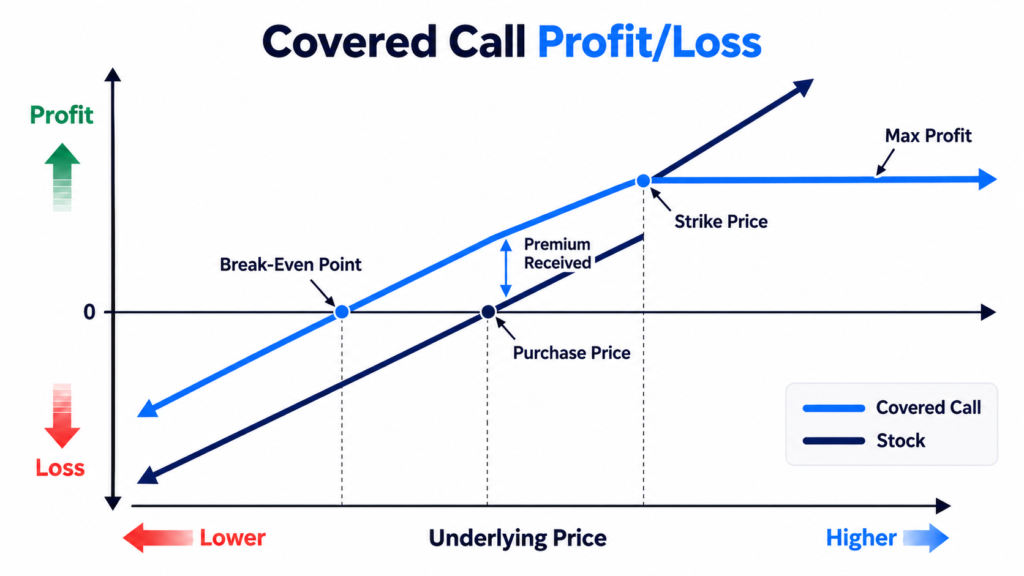
For a retiree who already owns stocks they are comfortable holding, a covered call may provide an additional way to collect income. However, it is important to understand what happens if the stock price moves strongly in either direction. If the stock falls, the premium collected may only offset a small part of the loss in the shares. If the stock rises well above the strike price, the investor may have to sell the shares at the agreed strike price and miss part of the upside.
Covered calls can be useful, but they are not risk-free. The biggest risk is still the stock itself. Selling a call does not protect an investor from a major decline in the underlying shares.
Another strategy that retirees may come across is the cash-secured put. With this strategy, the investor sells a put option and keeps enough cash available to purchase 100 shares of the stock if assignment occurs.
This strategy can make sense for someone who already wants to own a particular stock at a lower price. The investor collects premium while waiting, and if the stock falls below the strike price, they may be assigned the shares at that strike.
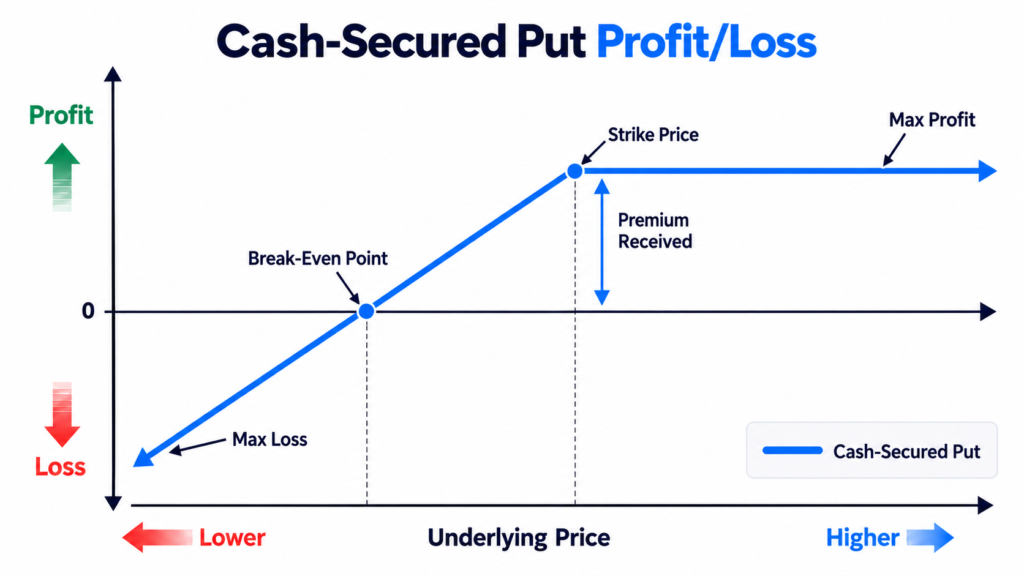
Again, the important part is the intention behind the trade. A cash-secured put should not simply be viewed as a way to collect premium. Before selling the put, the investor should be comfortable owning the stock if the trade is assigned. If the company drops sharply because of bad news, the investor could end up buying shares at a price that is much higher than the current market price.
That is why stock selection, position size, and the amount of cash being committed still matter.
A collar strategy may be worth considering for retirees who already own a stock and want some protection against a large drop in price. The strategy usually involves owning the stock, buying a protective put, and selling a covered call at the same time.
The put helps limit downside risk if the stock falls sharply, while the premium received from the call can help reduce the cost of that protection. In exchange, the investor gives up some of the potential upside because the stock may be called away if it rises above the call strike price.
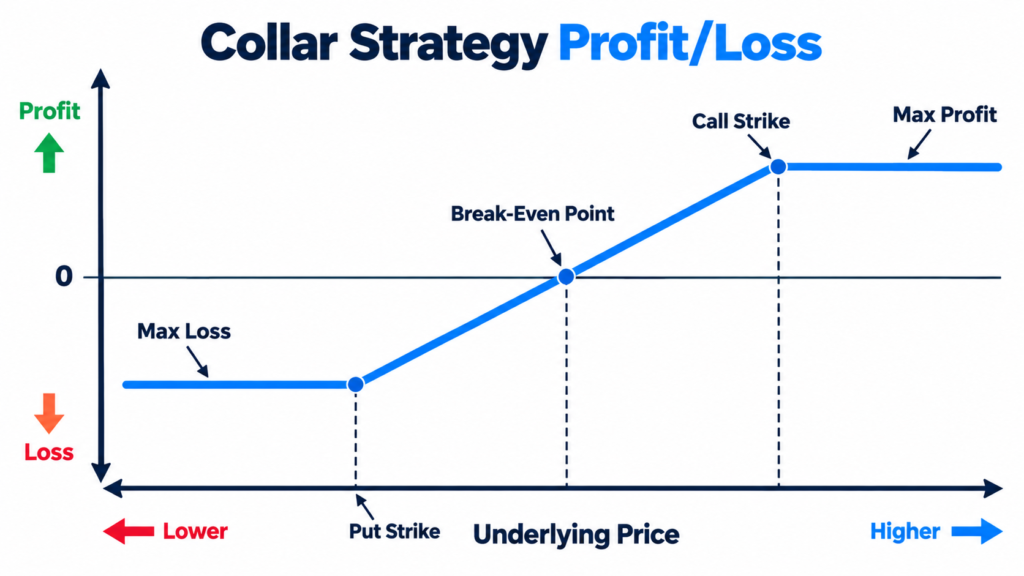
Unlike a covered call or cash-secured put, a collar is not mainly designed to generate income. Its main purpose is usually to protect the value of a stock position while keeping the cost of that protection more manageable.
For retirees, this can be especially useful when protecting capital is just as important as generating income. A collar will not remove all risk, but it can create a clearer range of possible outcomes and help reduce the impact of a large market decline.
Risk management is important for every trader, but it can become even more important during retirement. A younger investor who suffers a large loss may still have decades of employment income and investing ahead of them. A retiree may not have the same opportunity to rebuild the account.
This is one reason using an entire retirement portfolio for options trading can create unnecessary risk. Keeping part of the portfolio in cash or in other investments can provide flexibility and reduce the pressure to trade constantly.
Retirees also need to think about how much of their living expenses depend on the trading account. If losing money on a trade means struggling to pay normal monthly expenses, the position may already be too large.
A good trading plan should consider not only how much can be made if the trade works, but also what happens if the trade does not work.
No. In fact, one of the most important decisions a trader can make is deciding how much capital not to trade.
Keeping available cash can help in several ways. It may provide room to adjust positions, deal with assignment, enter new opportunities, or simply stay out of the market when conditions are not favorable.
Using all available capital may feel efficient when trades are going well, but it can quickly become a problem when several positions move against you at the same time.
Retirement trading should not be about keeping every dollar working every day. Sometimes having cash available is part of the strategy.
Options trading is often described as a way to generate income, but it should not be confused with completely passive income. Even relatively simple strategies require attention.
A covered call may need to be monitored if the stock moves sharply. A cash-secured put may be assigned. A spread can move quickly near expiration. Volatility can change, earnings announcements can affect option prices, and market conditions can change faster than expected.
Some traders spend only a limited amount of time managing positions, while others are much more active. The amount of work depends on the strategy, but retirees should understand that options trading still requires learning, planning, monitoring, and decision-making.
In that sense, options trading may support retirement income, but it is still a skill rather than a paycheck.
One of the biggest mistakes someone can make is waiting until retirement to begin learning options and then immediately expecting the account to produce income.
Options take time to understand. A trader needs to learn basic concepts such as strike prices, expiration dates, option premium, implied volatility, assignment, and the Greeks. More importantly, they need experience seeing how different strategies behave when the market moves.
Paper trading can be useful for learning how orders work and testing a process without immediately putting real capital at risk. Starting with smaller positions can also help a trader understand the emotional side of trading before larger amounts of money are involved.
The goal should be to build a repeatable process. That means knowing why you are entering a trade, how much you are willing to risk, what you will do if the trade moves against you, and when you plan to exit.
Options trading is not automatically safe or dangerous. The level of risk depends heavily on the strategy, the underlying investment, the amount of capital being used, and how the position is managed.
A covered call may look conservative compared with buying short-term call options, but the investor still owns the stock and can suffer losses if the stock falls. A cash-secured put may generate premium, but the trader may be required to buy shares during a market decline. A credit spread may have defined risk, but a trader can still lose the full amount at risk.
The important question is not whether options are safe in general. A better question is whether a particular strategy makes sense for your goals, your portfolio, and the amount of risk you are comfortable taking.
For retirees, protecting capital should usually remain part of that conversation.
Options can give investors more choices in how they manage a portfolio. They can potentially be used to generate premium, enter stock positions, manage risk, or create defined-risk trades. But each of those benefits comes with conditions and trade-offs.
At Dorian Trader, the focus is on helping traders understand how options strategies work before putting capital at risk. Learning how covered calls, cash-secured puts, spreads, collars, and other strategies behave in different market conditions can help traders make more informed decisions rather than simply chasing premium.
If you are approaching retirement or already retired, the goal should not be to find a strategy that promises easy monthly income. The goal is to understand the tools available, know the risks, and develop a trading plan that fits your own financial situation.
Join the Dorian Trader Club to learn alongside other traders, share insights, and continue developing your trading skills as part of a supportive community.
1. Lorem ipsum dolor sit amet, consectetur adipiscing elit. Ut elit tellus, luctus nec ullamcorper mattis, pulvinar dapibus leo.