
To build wealth for the future, you do not necessarily need to find one perfect investment or make one big financial decision. More often, long-term wealth comes from consistently putting money toward your future and giving it time to grow.

But that raises an important question: How much should you actually invest?
Is $100 a month enough to make a difference? Should you aim for $500 or $1,000? Or is it better to think about investing as a percentage of your income rather than a fixed dollar amount?
There is no single number that works for everyone. Your income, expenses, debt, financial goals, and time horizon all affect how much you can reasonably invest. However, established savings benchmarks and long-term growth examples can provide a useful starting point.
A fixed dollar amount does not tell the whole story. Investing $500 a month may be manageable for one household and unrealistic for another. Looking at your contribution as a percentage of income can provide a more flexible way to think about your long-term goals.
Fidelity, for example, suggests aiming to save at least 15% of your pre-tax income each year for retirement, including employer contributions. The company also notes that the appropriate savings rate depends on factors such as when you begin saving, when you plan to retire, and the lifestyle you expect to maintain.
Vanguard provides a similar benchmark, suggesting that investors consider saving roughly 12% to 15% of their pay each year for retirement, including employer contributions
These percentages are useful reference points, not universal rules. Someone paying down high-interest debt or building an emergency fund may not be able to reach those levels immediately. Someone who begins later or has more ambitious financial goals may eventually need to save more.
Instead of focusing only on a dollar amount, it can be useful to ask: What percentage of my income can I consistently put toward my future?
You do not necessarily need a large amount of money to begin investing. But how much difference could the size of your monthly contribution make over time?
To explore that question, we used the Compound Interest Calculator from Investor.gov, an investor education website from the U.S. Securities and Exchange Commission. We compared monthly contributions of $100, $500, and $1,000 while keeping the other assumptions the same.
Each scenario starts with a $1,000 initial investment and runs for 30 years using a hypothetical 5% estimated annual interest rate with annual compounding.
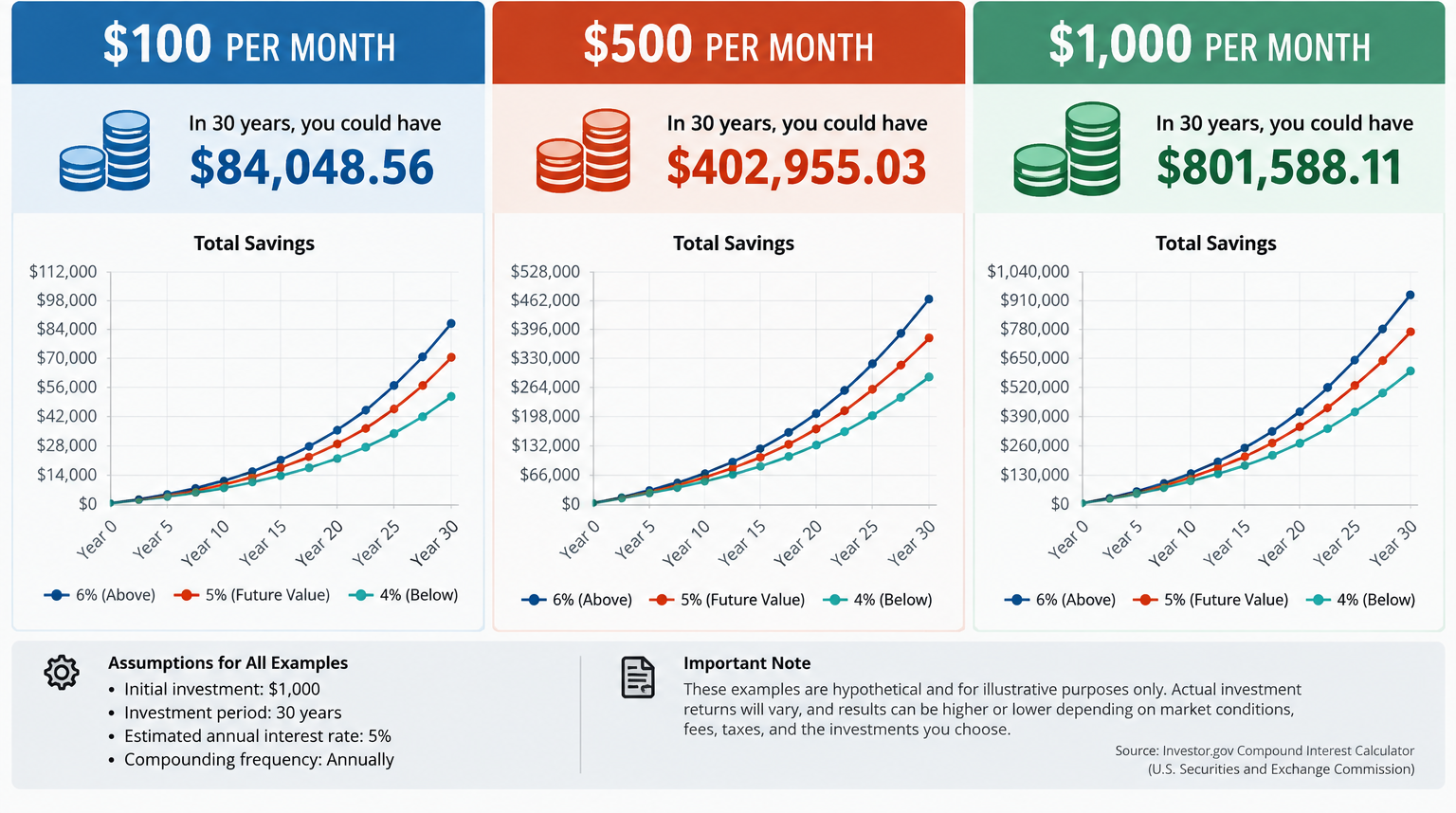
Source: Investor.gov Compound Interest Calculator, U.S. Securities and Exchange Commission.
The difference becomes substantial over a 30-year period. Under these hypothetical assumptions, higher monthly contributions result in a much larger ending value. The comparison is not meant to suggest that everyone should invest $1,000 per month. Instead, it illustrates how contribution size, consistency, and time can work together when pursuing long-term wealth.
Contribution size is only one part of long-term wealth building. Time also matters because compounding allows returns generated by an investment to potentially generate additional returns. As an investment grows, future returns may be earned on both the original contributions and previous gains.
A longer time horizon therefore gives invested money more opportunity to potentially compound. Real markets, however, do not produce a fixed return every year. Some years bring gains and others losses, so compound-growth illustrations should be viewed as mathematical examples rather than guarantees of future performance.
The amount you invest today does not have to be the amount you invest forever.
Suppose $100 per month fits your budget right now. You might begin there, increase it to $200 after a raise, and eventually work toward $500 or more as your financial situation changes.
The same idea can apply to percentage-based goals. If saving 15% of your income is unrealistic today, starting with a smaller percentage and gradually increasing it may be more sustainable than setting a target you cannot maintain.
A manageable contribution that you can gradually increase may be more sustainable than an aggressive target that forces you to stop investing altogether.
Putting more money into investments is not automatically the best decision in every situation.
Before increasing your contributions, consider the rest of your financial picture. Do you have cash available for unexpected expenses? Are you carrying high-interest debt? Will you need the money you are considering investing within the next few years?
Money intended for a long-term goal generally has more time to recover from market fluctuations. Money needed for an upcoming bill or emergency does not have the same flexibility.
This distinction is important because building wealth is not simply about maximizing the amount invested. It is also about creating a financial structure that makes it possible to stay invested through different market environments.
Trying to build wealth faster by taking more investment risk can be tempting, but greater potential returns generally come with greater uncertainty and the possibility of larger losses.
Whether you invest in stocks, use options as part of a broader portfolio, or combine different asset classes, risk should be considered alongside potential return.
Position size, diversification, time horizon, and the amount of capital exposed to loss all matter. A strategy capable of generating a high return may still be inappropriate if the potential loss could seriously damage your financial plan.
This becomes particularly important when both active trading and long-term investing are part of your approach. Money allocated to active trading may serve a very different purpose from capital intended for retirement or another long-term goal.
Building wealth is not only about asking how much you could make. It also requires understanding how much you can afford to risk.
There is no universal dollar amount or percentage that guarantees future wealth. Retirement savings benchmarks can provide a useful reference point, but the right contribution depends on your income, expenses, debt, goals, and time horizon.
A practical starting point is to ask: How much can I consistently invest without putting my current financial stability at risk?
Start with an amount you can sustain, increase it as your financial situation improves, and keep your long-term goals and risk tolerance in mind. Building wealth is less about finding one perfect number and more about creating a plan you can realistically maintain over time.
Want to keep building your trading knowledge? Join the Dorian Trader Trading Club for live education, practical trading discussions, and a community of traders working to improve their skills.
1. Lorem ipsum dolor sit amet, consectetur adipiscing elit. Ut elit tellus, luctus nec ullamcorper mattis, pulvinar dapibus leo.