
Every day trader eventually faces a losing trade, which is why risk management is such an important part of trading. The real question is not whether that loss will happen, but how much of your account you are willing to put at risk when it does. A $100 loss may be manageable in one account, while the same trading decision with a much larger position could turn into a setback that takes weeks or months to recover from.

This is why day trading risk management starts before the trade is placed. Rather than focusing only on where to enter or how much profit a setup might produce, traders need to determine how much they are prepared to lose, where they will exit if the trade moves against them, and what position size allows them to stay within that limit.
There is no single percentage that works for every trader because account size, trading experience, strategy, volatility, and personal risk tolerance can all influence how much risk makes sense. However, a commonly discussed guideline is to limit the amount at risk on an individual trade to around 1% or less of your trading capital.
For a trader with a $20,000 account, risking 1% would mean planning for a maximum loss of $200 on a trade, while a more conservative 0.5% limit would reduce that amount to $100. These percentages are not rules that every trader must follow, but they illustrate an important principle: no individual trade should have the power to cause serious damage to your account.
It is also important to understand that risk per trade and position size are not the same thing. A trader could purchase $5,000 worth of stock without necessarily risking the entire $5,000. If the stock is purchased at $50 and the trading plan calls for exiting at $49, the planned risk is $1 per share. With 100 shares, that represents $100 of planned risk, although fast-moving markets, gaps, and slippage can cause an actual loss to exceed the amount originally planned.
One of the easiest mistakes to make in day trading is deciding how many shares or contracts to trade first and thinking about risk afterward. A more disciplined approach is to identify where the trade no longer makes sense, determine how much you are willing to lose if that happens, and then calculate a position size that fits within that limit.
The basic calculation is straightforward:
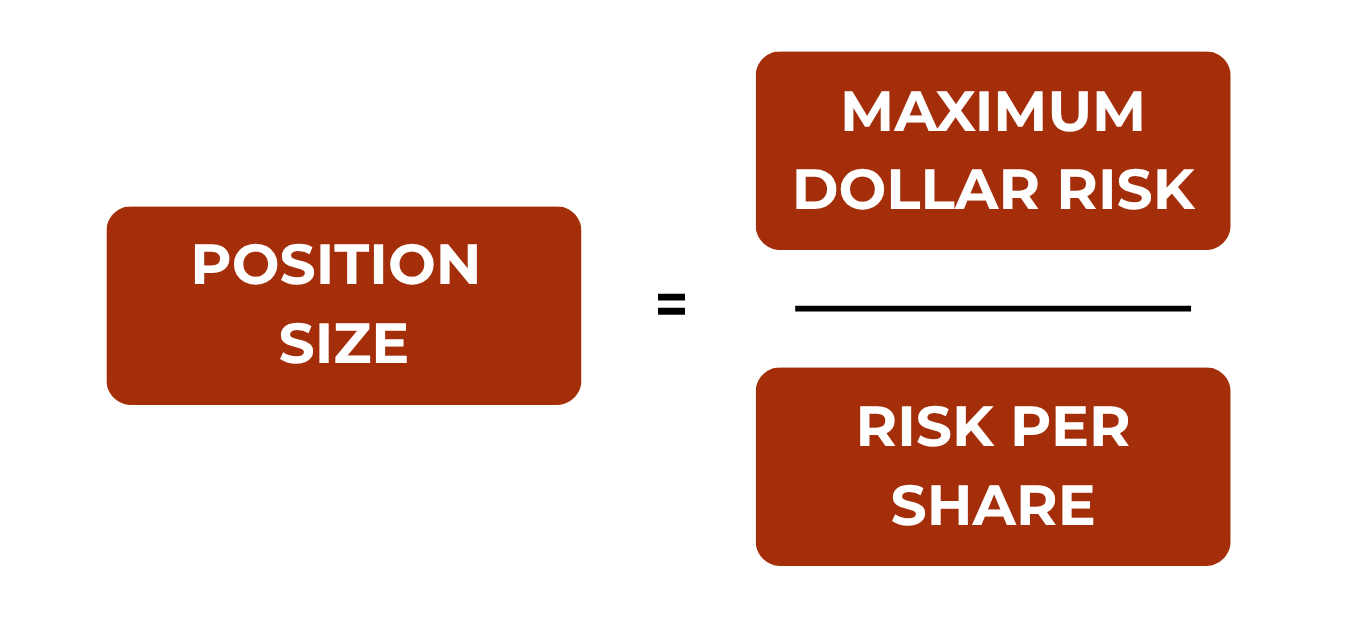
Imagine that a stock is trading at $75 and your analysis suggests that the trade would no longer be valid below $74.50, creating $0.50 of planned risk per share. If your maximum acceptable loss is $150, dividing $150 by $0.50 gives you a position size of 300 shares.
Now suppose market conditions require a wider stop at $73.50. Your risk has increased to $1.50 per share, but that does not necessarily mean you need to accept three times as much account risk. Instead, maintaining the same $150 maximum risk would reduce the position to 100 shares.
This relationship between the stop and position size is an important part of day trading risk management because it allows the trade setup to determine the size of the position rather than allowing the desired position size to dictate how much risk you take.
The importance of controlling risk becomes much clearer when losses begin to occur consecutively. Returning to our two traders with $20,000 accounts, suppose one risks 1% of the remaining account on every trade while the other risks 10%. After five consecutive losses, the first trader would have approximately $19,020 remaining, while the second would be left with about $11,810.
The problem with a large drawdown is not simply the money that has already been lost; it is also the return required to recover it. A 10% loss requires approximately an 11.1% gain to return to the starting balance, while a 25% loss requires about a 33.3% gain. Lose 50% of an account, and the remaining capital must produce a 100% return just to get back to the original balance.
This is why trading smaller can sometimes provide an advantage that is easy to overlook. Smaller positions do not guarantee profitable trades, but they can reduce the impact of mistakes, give traders more room to survive normal losing streaks, and make it less likely that one decision will determine the future of the entire account.
Good trading isn’t only about finding winning setups; it’s also about knowing how to manage risk when a trade doesn’t go as planned. In the video below, O’Brian explains why strong risk management can matter more than being a great trader.
Managing the risk of each individual position is important, but day traders also need to think about their total exposure throughout the trading session. A trader who carefully limits each trade to $100 of risk can still create a large loss by continuing to trade after several unsuccessful setups.
For this reason, some traders establish a maximum daily loss in addition to their risk-per-trade limit. If the planned risk is $100 per trade, for example, a trader might decide in advance that reaching $300 in losses means trading is finished for the day. The appropriate limit will vary from trader to trader, but the important part is making that decision before emotions begin influencing the process.
Without a predetermined limit, a losing trade can lead to another trade taken primarily to recover the first loss, followed by a larger position intended to recover both. This pattern is commonly known as revenge trading, and it can transform a normal losing session into a much more damaging one.
Knowing when to stop is part of managing risk too.
Limiting downside does not mean ignoring potential profit, because traders also need to consider whether the expected reward justifies the amount they are putting at risk. If a trader is willing to lose $100 for the possibility of making $200, the planned risk-to-reward relationship is 1:2.
This relationship also helps explain why win rate should not be considered by itself. Imagine a trader takes ten trades, loses $100 on six of them, and makes $200 on the other four. The six losing trades produce $600 in losses, while the four winners produce $800 in gains, leaving a hypothetical $200 gain before commissions, fees, slippage, taxes, and other trading costs.
In this simplified example, the trader was right only 40% of the time but still produced a positive result because the average winner was larger than the average loser. A high win rate can feel reassuring, but controlling the size of losses relative to winners may ultimately be more important than simply being right more often.
Effective day trading risk management begins before you enter a trade. Traders should already have an idea of where they will exit if the trade moves against them, how much of their account they are willing to risk, and what position size keeps the potential loss within that limit.
The frequently discussed 1% guideline can provide a useful starting point, but it should not be treated as a universal rule. Some traders may choose 0.5%, 0.25%, or another amount depending on their strategy, account size, experience, volatility, and tolerance for risk. What matters is having a defined limit and applying it consistently rather than changing the amount based on emotion or confidence in a particular setup.
Day trading will always involve uncertainty, and no stop loss or position-sizing method can guarantee that a loss will remain exactly where you planned it. What traders can do is decide how much risk they are prepared to accept before entering a position and avoid allowing one trade—or one bad day—to become disproportionately important to their account.
Before asking “How much can I make on this trade?”, it may be more useful to ask:
How much am I willing to lose if I’m wrong?”
That question is at the heart of managing risk.
1. Lorem ipsum dolor sit amet, consectetur adipiscing elit. Ut elit tellus, luctus nec ullamcorper mattis, pulvinar dapibus leo.