
Interest rates influence nearly every part of the financial market. Changes in the Fed rate can affect Treasury yields, stock prices, market volatility, and option premiums. On September 16, 2026, the Federal Reserve raised interest rates by 25 basis points, and the market reaction showed how closely these parts of the financial market are connected.
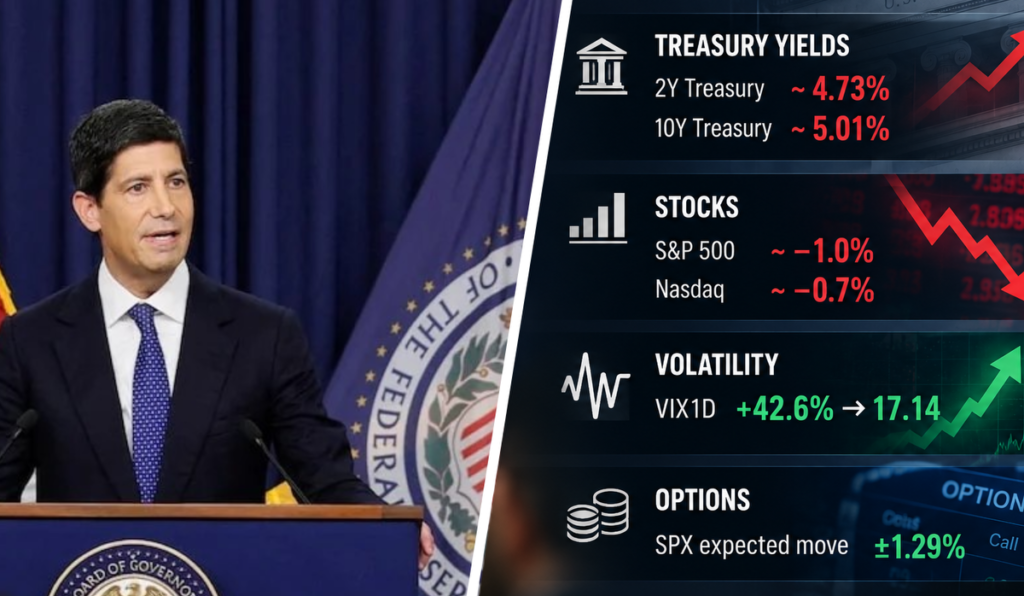
Treasury yields are closely watched around a Fed decision because they reflect expectations for future interest rates, inflation, and the economy. When investors expect rates to stay higher, Treasury yields can move higher as the bond market adjusts. That can create pressure on stocks because higher yields increase the discount rate used to value future corporate earnings. Future cash flows become less valuable in today’s dollars, while government bonds may also become more attractive compared with stocks.
Here is how the market moved around the September 16 Fed decision:
Stocks had traded higher earlier in the session before turning lower as investors digested the Fed’s decision and the outlook for interest rates. Late in the session, the S&P 500 was down about 1.0%, while the Nasdaq was down around 0.7%. The reaction was not simply about the 25-basis-point increase. Investors were also trying to determine what the Fed’s decision meant for how long interest rates could remain elevated.
Fed decisions can also have a noticeable impact on the options market. Before a major announcement, traders do not know exactly what the Fed will say or how stocks will respond. That uncertainty can push implied volatility higher, which generally makes option premiums more expensive when other factors remain unchanged.
Around the September 16 announcement, VIX1D rose 42.6% to 17.14, reflecting a sharp increase in very short-term expected volatility. SPX options were also pricing an expected move of approximately ±1.29%. That number does not tell us whether the S&P 500 will move higher or lower. It simply tells us how much movement the options market is pricing over that period.
Once the Fed announcement is out, the market has more information and some of that uncertainty may disappear. Implied volatility and option premiums can then change quickly, even if the underlying index does not make a particularly large move. This is why options can react differently from stocks around major Fed announcements.
A rate hike does not automatically mean stocks will fall, Treasury yields will rise, or options will become more expensive. Markets are constantly looking ahead, and an expected Fed decision may already be reflected in prices before the announcement happens.
If investors are expecting a 25-basis-point hike and the Fed delivers exactly that, the rate increase itself may not be the biggest driver of the market reaction. Attention can quickly shift to what the Fed says about inflation, the economy, and where interest rates may go next. If that outlook is different from what investors expected, Treasury yields, stocks, and volatility can all move as the market adjusts.
That is why the headline “Fed raises rates” only tells part of the story. The more important question for investors and options traders is how the decision changes expectations for what comes next. Those changing expectations can move Treasury yields, affect stock valuations, and change the amount of volatility being priced into options.
Keep Learning with Dorian Trader
Want to learn more about the markets and options trading? Dorian Trader regularly hosts free webinars covering options strategies, market concepts, and trading education. Join an upcoming session to learn directly from our instructors and continue building your understanding of the market.
1. Lorem ipsum dolor sit amet, consectetur adipiscing elit. Ut elit tellus, luctus nec ullamcorper mattis, pulvinar dapibus leo.