
Options can provide another way to approach retirement income, but the goal is not to chase the largest premium. It is to understand the strategy, control the risk, trade an appropriate size, and protect the capital you may need for years to come.

Retirement changes the way many people think about investing because the objective is often no longer simply to grow an account as quickly as possible. When regular employment income slows or stops, protecting the money you have accumulated becomes increasingly important, while generating additional cash flow from that capital can also become part of the financial picture.
This is one reason options attract the attention of retirees. Strategies such as the Wheel, the Poor Man’s Covered Call, and the Iron Condor can all be used to collect option premium, but that does not mean they provide guaranteed income or that one of them should automatically become a “retirement strategy.”
A better way to think about options in retirement is to ask a different question: What strategy fits the situation, and how much risk am I willing and able to take?
That distinction matters because the strategy itself is only one part of the trade. The underlying investment, position size, market conditions, available capital, and the trader’s ability to manage the position can be just as important.
Someone who is decades away from retirement may be willing to tolerate significant market swings while pursuing long-term growth, but a retiree who expects to use portfolio assets for living expenses may view the same loss very differently. A large drawdown is not simply uncomfortable; it can reduce the amount of capital available to generate future income and may be difficult to replace without new employment income.
For this reason, retirement options trading should begin with capital preservation rather than an income target. Receiving premium can be useful, but premium received is not the same as profit earned, because every premium comes with an obligation and some form of risk.
The objective, therefore, should not be to find the strategy that produces the most income. It should be to understand which strategy makes sense for the current situation, define the risk before committing capital, and keep the position small enough that one unfavorable trade does not materially damage the retirement portfolio.
It is tempting to label certain strategies as safe and others as risky, but options rarely work in such simple categories. A defined-risk strategy can still create a large loss when traded at an excessive size, while a relatively conservative strategy can become dangerous when it is used on a highly speculative stock simply because the premium looks attractive.
For retirement traders, safety is better understood as a combination of several decisions: choosing an appropriate underlying asset, understanding the possible outcomes, knowing how much capital is committed, having a plan for an adverse move, and sizing the position according to what the account can reasonably absorb.
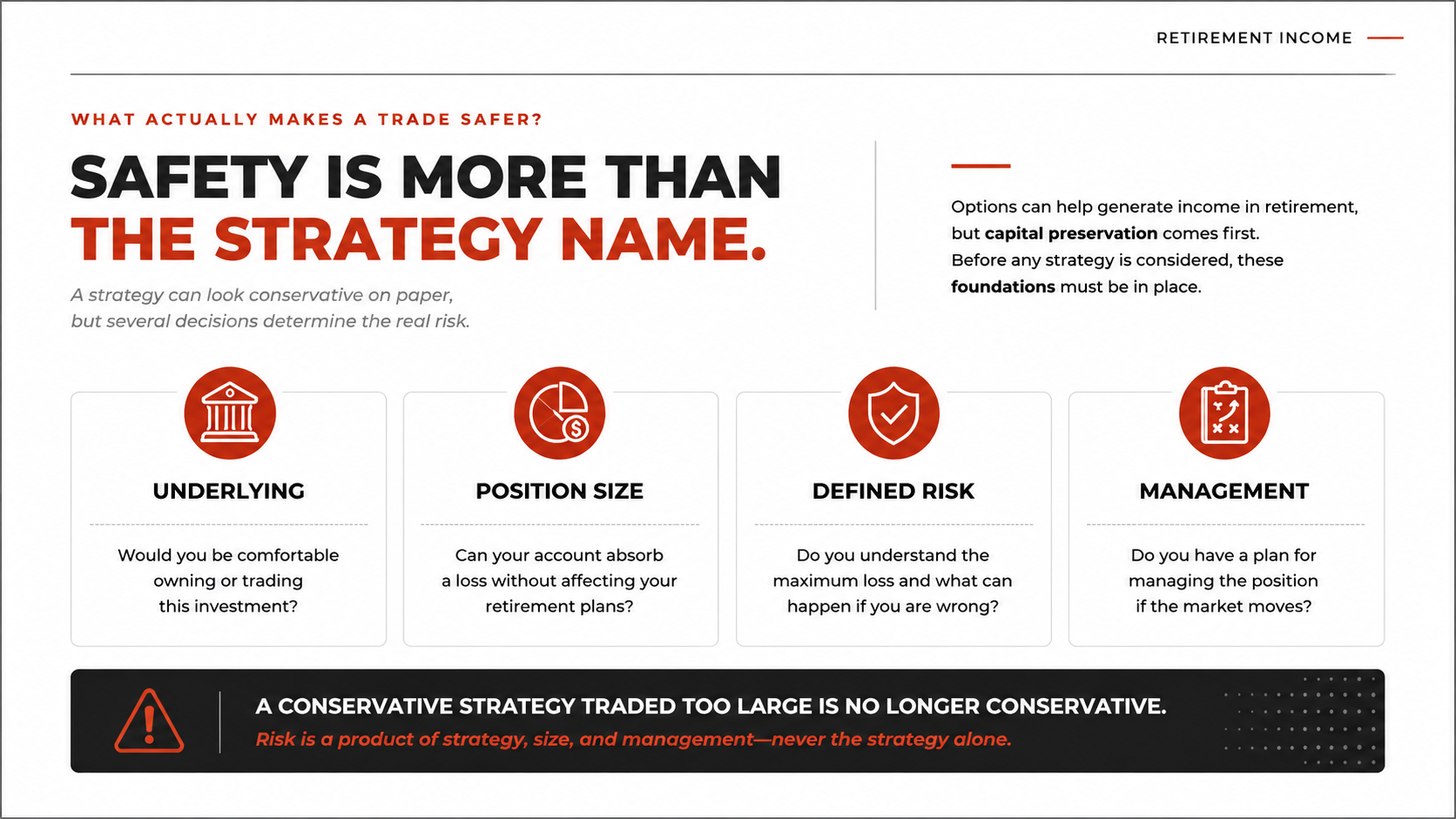
With that framework in mind, three popular options strategies illustrate three very different ways of approaching income.
The Wheel Strategy begins with a simple idea: rather than buying a stock immediately, an investor can sell a cash-secured put at a strike price where they would genuinely be comfortable owning the shares. If the put expires out of the money, the investor keeps the premium and can evaluate another opportunity; if assignment occurs, the investor purchases the shares at the strike price and can then consider selling covered calls against the position.
If those shares are eventually called away, the cycle can begin again.
What makes the Wheel interesting is not simply the amount of premium collected along the way. Its value comes from connecting options income with decisions the investor was already willing to make: buying a quality stock at an acceptable price and potentially selling it at a price they are comfortable receiving.
However, selling a cash-secured put should never be viewed as free income while waiting for a stock to fall. If the company declines substantially, the investor can still be assigned above the current market price and experience a meaningful loss. That is why the first question should not be, “How much premium can I collect?” but rather, “Would I still want to own this company if the stock dropped after I entered the trade?”
A traditional covered call generally requires ownership of 100 shares, which can require substantial capital when the underlying stock has a high share price. A Poor Man’s Covered Call, or PMCC, approaches the same basic idea differently by using a longer-dated, deep-in-the-money call option as a substitute for owning the shares and then selling shorter-dated calls against that position.
This can reduce the amount of capital required compared with purchasing 100 shares outright, which is why the PMCC is often described as a capital-efficient strategy.
But capital efficiency should not be confused with permission to trade larger.
Using less capital does not remove risk, because the long call can lose value, time decay matters, volatility can change, and the relationship between the long and short options needs to be understood. A trader who uses the capital savings to multiply the number of positions may actually increase overall portfolio risk rather than reduce it.
For a retirement investor, the educational value of the PMCC is therefore not simply that it can generate premium with less capital. It demonstrates an important principle: using capital efficiently is valuable only when the capital saved is not immediately converted into additional unnecessary risk.
Many investors enter the market believing every trade requires a bullish or bearish opinion, but options can also create positions designed around a range rather than a specific direction.
An Iron Condor typically combines an out-of-the-money put spread with an out-of-the-money call spread, allowing the trader to collect premium while defining risk on both sides of the position. The trade generally benefits when the underlying remains within a certain range through the life of the position.
This makes the Iron Condor fundamentally different from the Wheel and the PMCC. Instead of beginning with stock ownership or bullish exposure, it demonstrates how options can be structured around the expectation that a market may remain relatively stable.
The important phrase, however, is defined risk—not small risk.
Knowing the maximum potential loss before entering a trade is useful, but a $3,000 defined maximum loss is still a $3,000 risk. If several similar positions are opened at the same time, portfolio exposure can grow much faster than it appears when each trade is viewed individually.
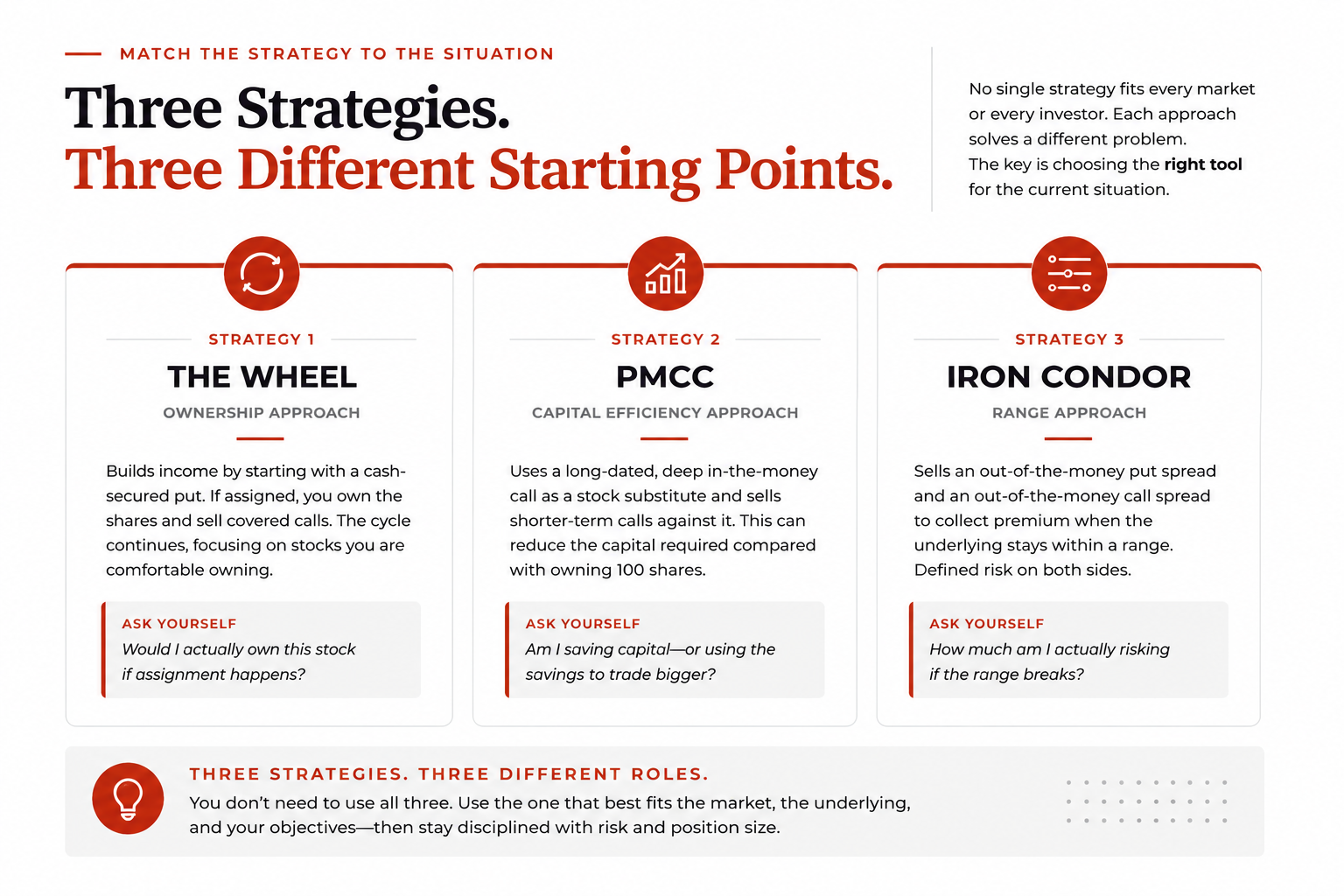
A reasonable strategy traded too large can quickly become an unreasonable risk, which is why position sizing deserves as much attention as strike selection, expiration dates, or potential premium.
Imagine two traders using exactly the same Iron Condor. One risks an amount that represents a small portion of available trading capital, while the other opens several contracts and commits a substantial portion of the account. The strategy is identical, but the financial and emotional consequences of a losing trade are completely different.
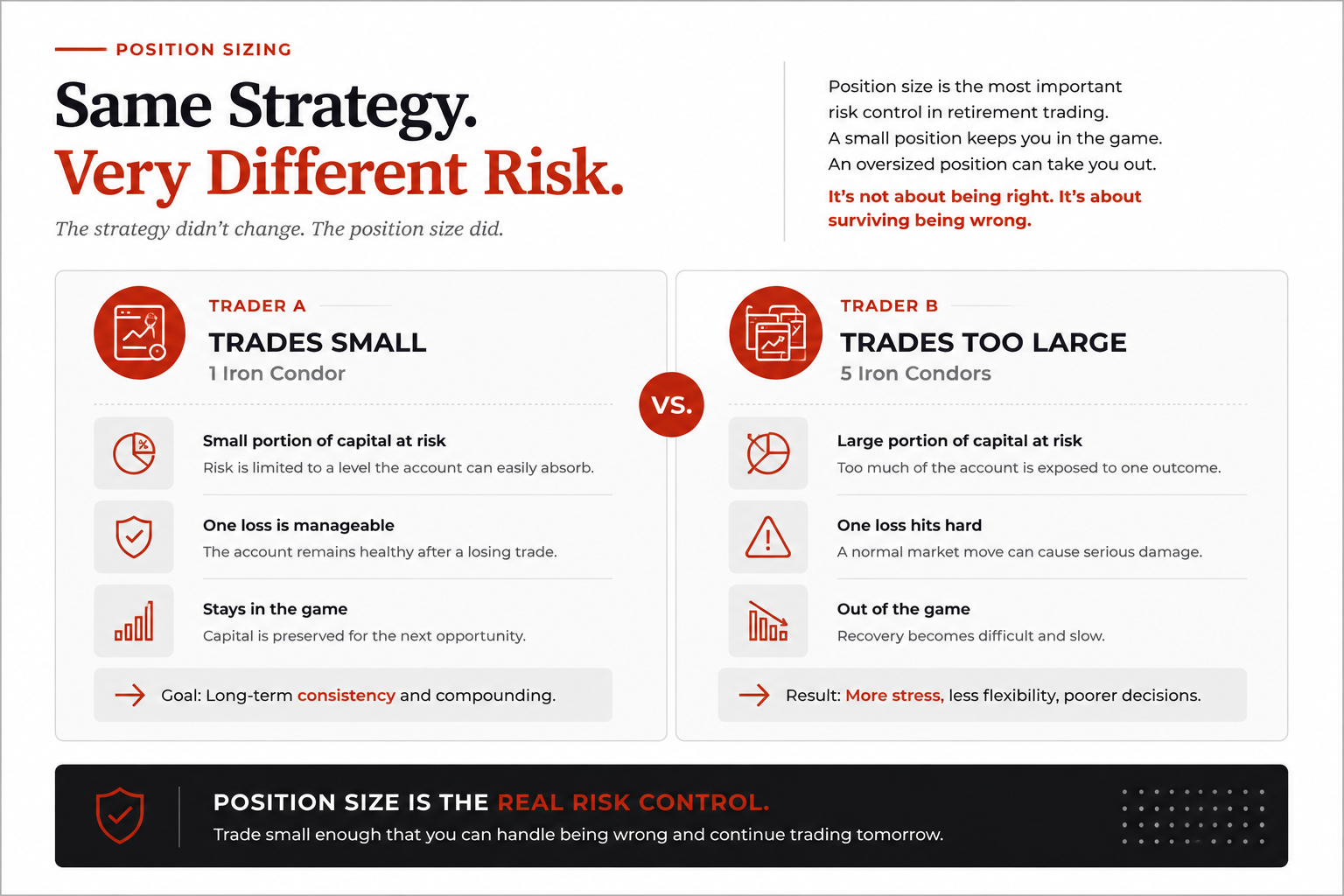
This principle becomes particularly important during retirement because capital that is lost may not be easily replaced. Trading smaller can mean collecting less premium today, but it also preserves flexibility to adjust, wait for another opportunity, and continue participating after an unfavorable trade.
One of the most dangerous ways to approach retirement options trading is to begin with a fixed income requirement and then increase risk until the portfolio appears capable of producing that number.
If someone decides, “I need my options account to generate $2,000 every month,” the market does not change simply because that income is needed. Some months may provide attractive opportunities, while others may offer fewer setups that justify the risk.
Trying to force the same income from every market environment can encourage traders to increase position size, move strikes closer to the current stock price, trade lower-quality underlying assets, or chase unusually high premiums.
A healthier approach is to allow risk management to determine the trade rather than allowing the desired income to determine the risk.
There will be periods when a good decision is to trade smaller, collect less premium, or simply wait. There will also be losing trades, assignments, and markets that move much farther than expected.
None of these automatically means a strategy has failed.
A sustainable process recognizes that no strategy wins all the time and that protecting capital sometimes requires accepting a small loss rather than allowing it to become a large one. It also means resisting the temptation to increase size after a winning streak or immediately trying to recover a loss with a larger trade.
For retirement traders, consistency and longevity can matter far more than excitement.
Options offer flexibility, but that flexibility also creates complexity, which is why understanding the mechanics of a strategy should come before depending on it for retirement cash flow. Learning how assignment works, understanding expiration and time decay, recognizing how volatility affects option prices, and knowing what can happen when the underlying moves sharply are all part of responsible options trading.
Starting small provides an opportunity to learn these lessons without placing a large portion of retirement capital at risk. As experience develops, a trader can evaluate what works for their objectives, temperament, and financial circumstances rather than simply following a strategy because it has been presented as a reliable source of income.
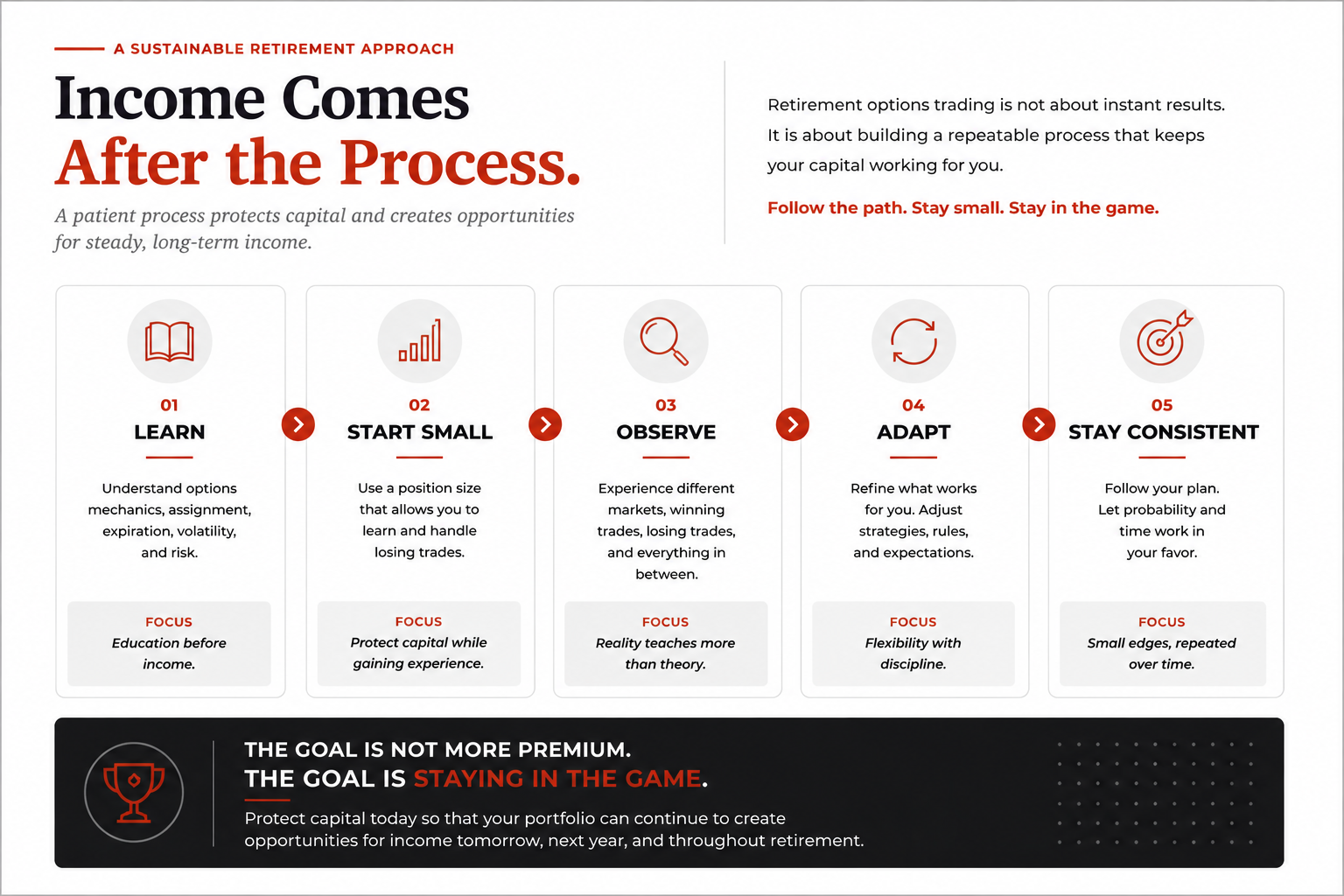
Options can become one component of a broader approach to retirement income, and strategies such as the Wheel, the Poor Man’s Covered Call, and the Iron Condor demonstrate how differently that income can be structured. What ultimately determines whether those strategies are appropriate, however, is not the size of the premium alone but the quality of the underlying position, the amount of capital committed, the risk being accepted, and the trader’s ability to remain disciplined when the market behaves differently than expected.
For a retirement trader, success should not be measured only by how much premium can be collected this month. A more sustainable measure is whether the portfolio remains healthy enough to provide opportunities next month, next year, and throughout retirement.
Trade small, understand the risk, and give yourself the opportunity to stay in the game.
Options involve risk and are not suitable for all investors. This article is for educational purposes only and should not be considered personalized investment, tax, or financial advice.
1. Lorem ipsum dolor sit amet, consectetur adipiscing elit. Ut elit tellus, luctus nec ullamcorper mattis, pulvinar dapibus leo.