
Wall Street is surprisingly optimistic about the S&P 500. Take a look at the latest forecasts from major banks and research firms. Despite all the headlines and concerns, the forecasts tend to be relatively high. The most bullish target is 8250!

Most investors see these numbers and move on. But what if there is a way to actually use this information?
Think about it. If the most optimistic professional forecast is 8250, how likely is it that the market finishes dramatically above that level?
Now let’s look at the downside. A typical bear market is defined as a 20% decline. With the S&P 500 currently near 7450, a 20% drop would bring the index to roughly 6000.
Combining Wall Street’s most optimistic forecast with a typical bear-market decline gives us a range where the S&P 500 could plausibly remain during 2026.
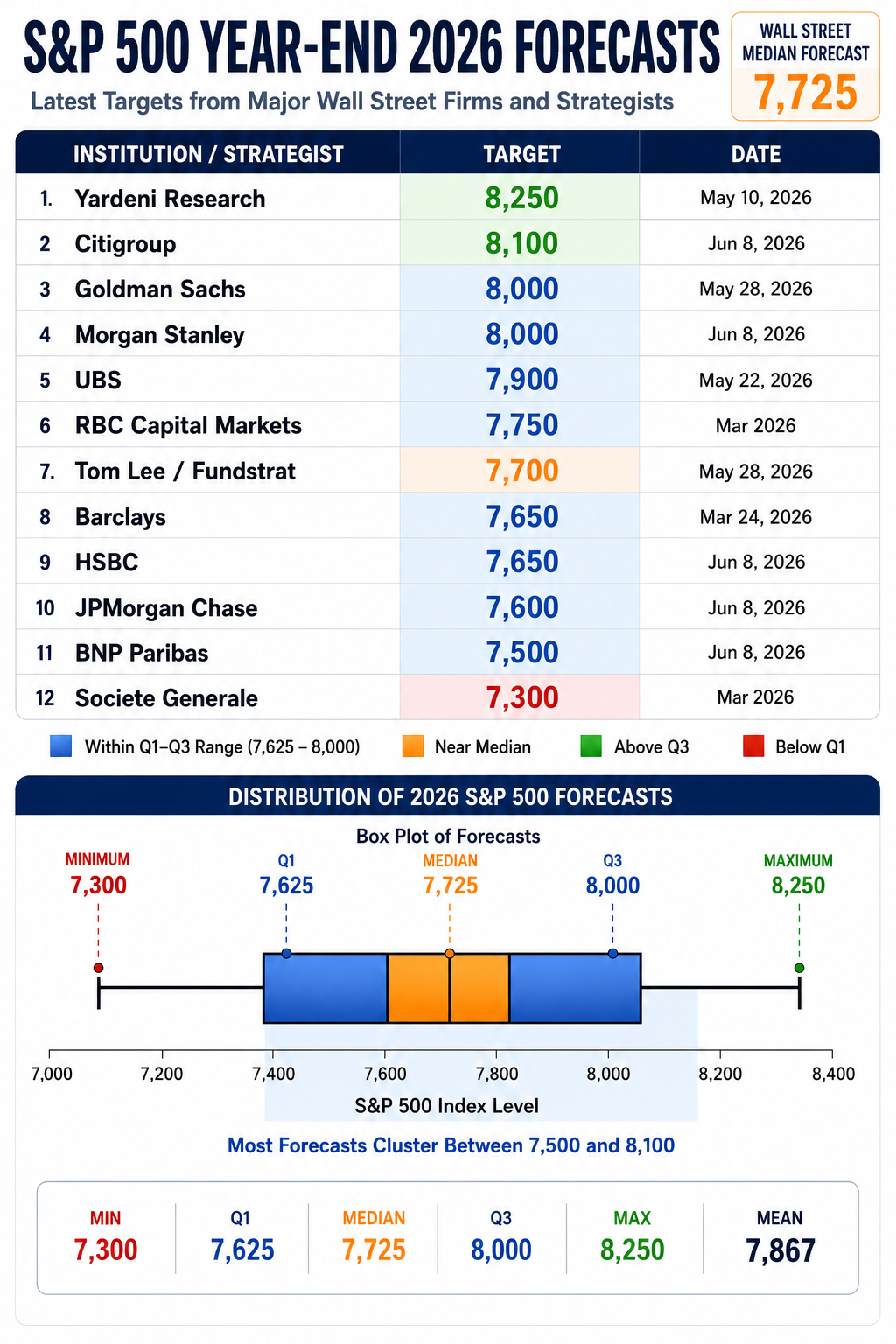
Can we build a trade around that idea? Instead of trying to predict whether the market will rise or fall next week, we can structure a trade that benefits if the S&P 500 stays within this known range.
One possible approach is to use an Iron Condor option strategy:
The trade does not require a strong bullish or bearish view. It only requires the market to avoid extreme outcomes and stay within 6000-8250.
Rather than guessing where the S&P 500 will finish the year, you are using information gathered from some of the largest investment firms in the world and building a position around their collective expectations.
Depending on volatility, strike selection, and risk management, traders may target annualized returns approaching 20%.
Don’t try to predict exactly where the market will go. Focus on where it is unlikely to go. If the S&P 500 remains between 6000 and 8250, using an Iron Condor you can target annualized returns near 20% while maintaining a high probability of profit.
Want to learn how to build trades like this and manage them systematically? Sign up and follow along!
1. Lorem ipsum dolor sit amet, consectetur adipiscing elit. Ut elit tellus, luctus nec ullamcorper mattis, pulvinar dapibus leo.