

DORIAN TRADER​​

How to Trade in High Volatility Markets Using Options

Volatility is one of the most misunderstood forces in the market. When prices begin to move rapidly and uncertainty increases, many traders become uncomfortable and assume that higher volatility automatically means higher risk. While volatility can increase risk for unprepared traders, experienced options traders often view it differently. In many cases, periods of elevated volatility create some of the most attractive opportunities in the market.

The reason is straightforward. Consistently predicting the direction of price movement is extremely difficult, even for skilled traders. Volatility, however, is often more observable and more tradable. That is why many professional options traders focus less on predicting direction and more on understanding how volatility is being priced. When market expectations become distorted, opportunities begin to appear.

Why Volatility Matters in Options Trading?

To understand why high-volatility environments can be attractive, it is important to recognize how options are priced. Every option contract reflects the market’s expectation of how much the underlying asset may move in the future, which is expressed through implied volatility (IV).

This means that options are not simply pricing direction. They are pricing uncertainty.

Many traders focus on whether the market will move up or down. Options traders often ask a more useful question: how much movement is already being priced in? This shift in perspective allows traders to evaluate whether volatility is being overestimated or underestimated and to structure trades accordingly.

The goal is not always to predict direction correctly. The goal is to recognize when volatility is being priced inefficiently and to take advantage of that imbalance.

Pros and Cons of Trading Volatility

While volatility creates opportunity, it also introduces additional challenges. Understanding both sides is essential before trading in these conditions.

 Advantages:

Larger price swings can create greater profit potential

Increased movement often leads to more trading opportunities

Higher trading activity can improve liquidity

Volatile markets provide valuable experience for developing trading skills

 Disadvantages:

Higher risk due to faster and more unpredictable price movements

Greater emotional pressure, including fear and impulsive decisions

Wider bid-ask spreads, increasing trading costs

More complex market behavior, especially for less experienced traders

Historical Volatility vs. Implied Volatility

A key concept in options trading is the relationship between historical volatility (HV) and implied volatility (IV).

Historical volatility reflects how much the asset has actually moved in the past, while implied volatility represents the market’s expectation of future movement. Comparing the two can help traders determine whether options are relatively expensive or cheap.

When IV is significantly higher than HV, options may be overpriced

When IV is lower than HV, options may be underpriced
Although this comparison does not guarantee profitable trades, it provides important context and helps traders avoid entering positions without understanding current market conditions.

VIX – A Measure of Market Volatility Expectations

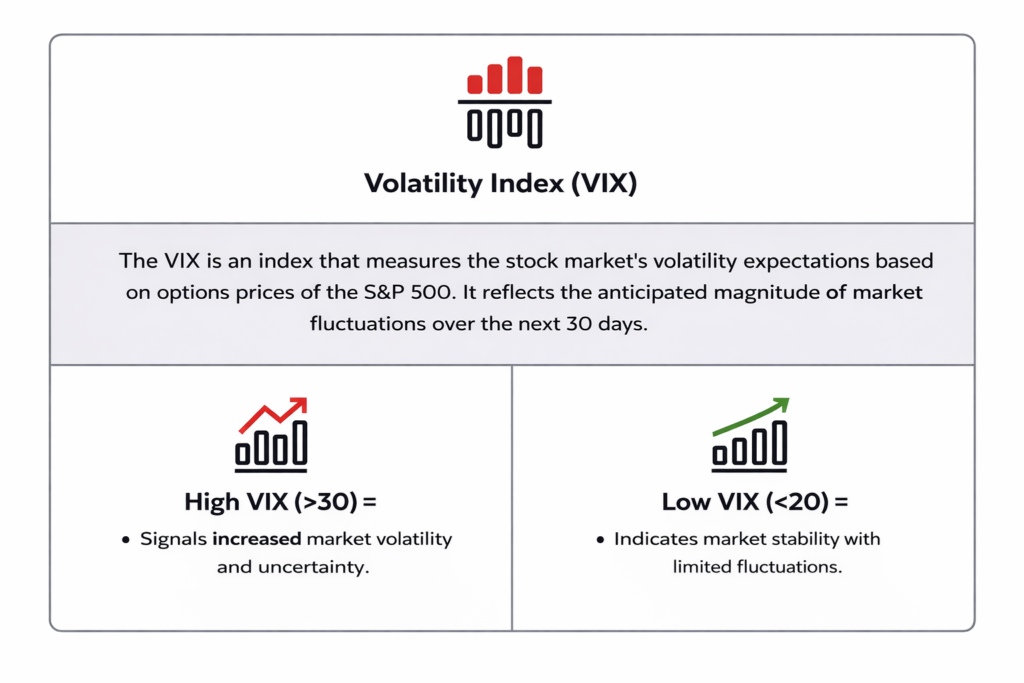
One of the most widely used indicators of market volatility is the VIX, often referred to as the “fear index.” Unlike historical measures, the VIX reflects the market’s expectation of future volatility, based on options pricing in the S&P 500.

In simple terms, the VIX represents how much movement traders expect over the coming weeks, typically over a 30-day period. Because it is derived from option prices, it provides insight into overall market sentiment and uncertainty. When the VIX rises, it signals that traders are expecting larger price swings, often associated with increased uncertainty or concern in the market. When the VIX is low, it suggests a more stable environment with relatively modest expectations for movement.

Traders often use the VIX to better understand the current market environment and to align their strategies with prevailing conditions, especially when trading options where volatility plays a central role.

 See how rising volatility creates opportunity and how traders use wide iron condors after red days in this video.

Why High Volatility Creates Opportunity

When volatility increases, option premiums tend to rise. This often occurs during periods of uncertainty, such as major economic events, earnings announcements, or sharp market movements.

In these situations, the market may begin to overprice risk as participants react emotionally. For options traders, this is significant because premium is the core component being traded.

If volatility is overpriced, traders may look to sell premium

If volatility is underpriced, traders may look to buy volatility

Opportunities arise not from predicting direction perfectly, but from understanding how volatility is being priced and identifying when those expectations are inaccurate.

How Options Traders Take Advantage of High Volatility

There is no single approach to trading volatile markets. The appropriate strategy depends on whether volatility is elevated, mispriced, or expected to change. However, it is important to recognize that high-volatility environments are not suitable for every trader. Fast-moving markets require discipline, emotional control, and a solid understanding of risk management. Without these, volatility can quickly lead to poor decisions and amplified losses rather than opportunity.

With that in mind, traders typically approach high-volatility conditions in different ways depending on how volatility is being priced.

 When Volatility Is High

Traders often favor premium-selling strategies such as:

  1. Credit spreads
  2. Iron condors
  3. Other defined-risk short premium positions

Higher implied volatility leads to higher option premiums, which can improve probabilities and enhance the effects of time decay.

 When Volatility Is Low or Mispriced

In situations where volatility is relatively low or expected to increase, traders may use:

  1. Straddles
  2. Strangles

These strategies are designed to benefit from large price movements, regardless of direction.

 Advanced Volatility Strategies

More experienced traders may use:

  1. Calendar spreads
  2. Ratio spreads
  3. Backspreads

These strategies take advantage of differences in volatility across time or price levels and require a deeper understanding of options pricing.

Risk Management in Volatile Markets

Volatility increases both opportunity and risk. In fast-moving conditions, losses can develop quickly if trades are not properly managed. For this reason, traders should:

Define maximum risk before entering a position

Control position size carefully

Have a clear adjustment or exit plan

Volatility does not create risk — it exposes poor risk management.

High-volatility markets can feel chaotic, but for options traders, they often present some of the most compelling opportunities. By focusing on how volatility is priced rather than attempting to predict direction, traders can approach the market with greater structure and clarity.

Understanding the relationship between implied and historical volatility, recognizing when options are mispriced, and aligning strategies with market conditions are all essential skills in these environments.

If you want to learn how experienced traders approach volatility, manage risk, and structure trades in real time, visit https://doriantrader.com/

 Join the Trading Club and learn alongside traders who are committed to mastering the craft.

Ready to Begin?

Start with structure, trade with confidence

Join the Dorian Trader Club

Start learning today and take control of your trading journey.
Click Here
Rules

1. Lorem ipsum dolor sit amet, consectetur adipiscing elit. Ut elit tellus, luctus nec ullamcorper mattis, pulvinar dapibus leo.