
When the stock market crashes, watching your investment portfolio lose value can be stressful, even for experienced investors. Negative headlines, falling stock prices, and fears of losing money can make you feel like selling everything before things get worse.

But is selling all your stocks really the right decision? Should you hold on to your investments, or could a market downturn actually present an opportunity to buy? There is no one-size-fits-all answer. The right decision depends on your financial goals, investment time horizon, risk tolerance, and personal financial situation. Instead of trying to predict exactly when the market will hit bottom, focus on understanding what is happening and developing a plan that works for you.
Here are five practical steps to help you navigate a stock market crash with greater confidence.
Not every market decline is a financial crisis. Stock prices naturally fluctuate, and market downturns are a normal part of investing. However, the size of a decline can help investors understand the market environment.
| Market decline | Meaning | What it means |
|---|---|---|
| −10% | Market correction | A decline of 10% or more from a recent peak. Corrections are common and do not necessarily indicate an economic recession. |
| −20% | Bear market | A decline of 20% or more from a recent peak, often associated with pessimism and economic uncertainty. |
| −30% | Severe market decline | A deep decline that may accompany economic instability; not a separate, formally defined market category. |
A Historic Example: Black Monday in 1987
One of the most dramatic stock market crashes in U.S. history occurred on October 19, 1987, known as Black Monday. On that day, the Dow Jones Industrial Average (DJIA) plunged 22.6% in a single trading session, marking its largest one-day percentage decline on record.
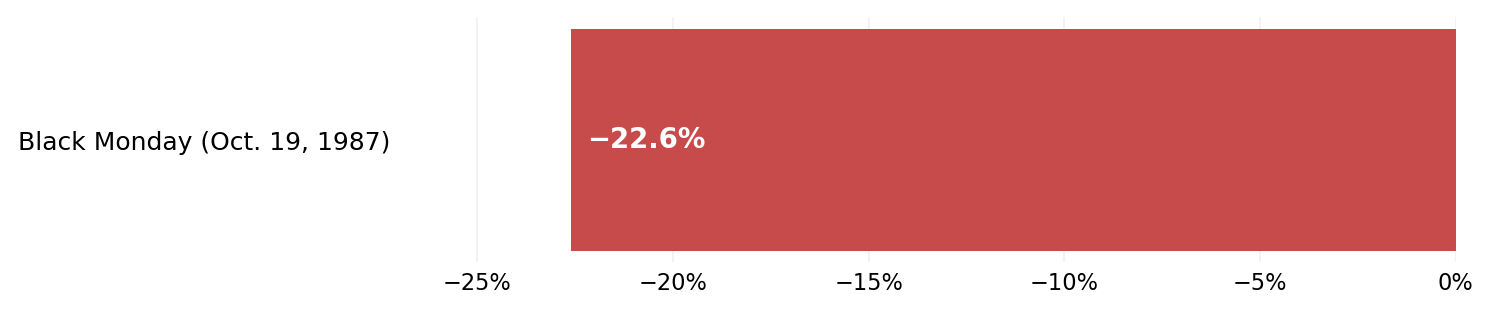
Figure 1. Dow Jones Industrial Average one-day change on Black Monday (historical percentage, not an intraday chart).
The 1987 crash demonstrated how quickly markets can fall. However, a crash does not necessarily mean stock prices will never recover. Historically, broad stock markets have recovered from major downturns, although recoveries can take years and individual stocks may never regain their previous values.
Key takeaway: Short-term market volatility should not automatically dictate your long-term investment decisions.
One of the most important questions to ask during a market crash is: When will you need the money you are investing?
If you plan to buy a home within the next year or two, a major decline could directly affect that goal. But if you are investing for retirement 20 years from now, you may have more time to ride out short-term volatility.
| Investment time horizon | General investment approach |
|---|---|
| Short-term: Under 3 years | Prioritize liquidity and capital preservation; consider savings accounts, short-term deposits, or relatively low-risk assets. |
| Medium-term: 3–5 years | Consider a balanced mix of assets, depending on your goals and risk tolerance. |
| Long-term: 5–10+ years | Consider a greater allocation to diversified stocks if you can tolerate volatility and potential losses. |
These time frames are general guidelines, not universal rules. Someone with a ten-year horizon but low risk tolerance may still prefer a conservative portfolio.
Matching your investments to your time horizon reduces the risk of being forced to sell stocks at depressed prices to pay for an upcoming expense. A longer investment horizon may offer more flexibility, but it does not eliminate risk or guarantee positive returns.
A stock market crash may coincide with job losses, reduced income, or other unexpected financial difficulties. Maintaining an emergency fund is therefore an essential part of financial planning.
A useful starting point is three to six months of essential living expenses. This includes housing, groceries, utilities, insurance, and minimum debt payments.
For example, if your essential monthly expenses total $2,000, your target emergency fund might look like this:
| Savings target | Calculation | Suggested amount |
|---|---|---|
| 3 months | $2,000 × 3 | $6,000 |
| 6 months | $2,000 × 6 | $12,000 |
If you are self-employed, your income is unpredictable, or your household depends on a single income, you may need a larger buffer. Keep emergency savings in a safe, accessible account rather than assets exposed to substantial market swings.
An adequate emergency fund can help you avoid selling investments at a loss simply to pay for everyday expenses. It also gives you the flexibility to make decisions based on long-term goals rather than immediate financial pressure.
Significant market declines can change the mix of assets in your portfolio. Suppose your investment strategy calls for 60% stocks and 40% bonds. If stocks fall sharply while bonds hold their value, your actual asset allocation will drift away from the original target.
Assume a $100,000 portfolio begins with $60,000 in stocks and $40,000 in bonds. If stocks decline 30% and bond values remain unchanged, the portfolio would be worth $82,000.
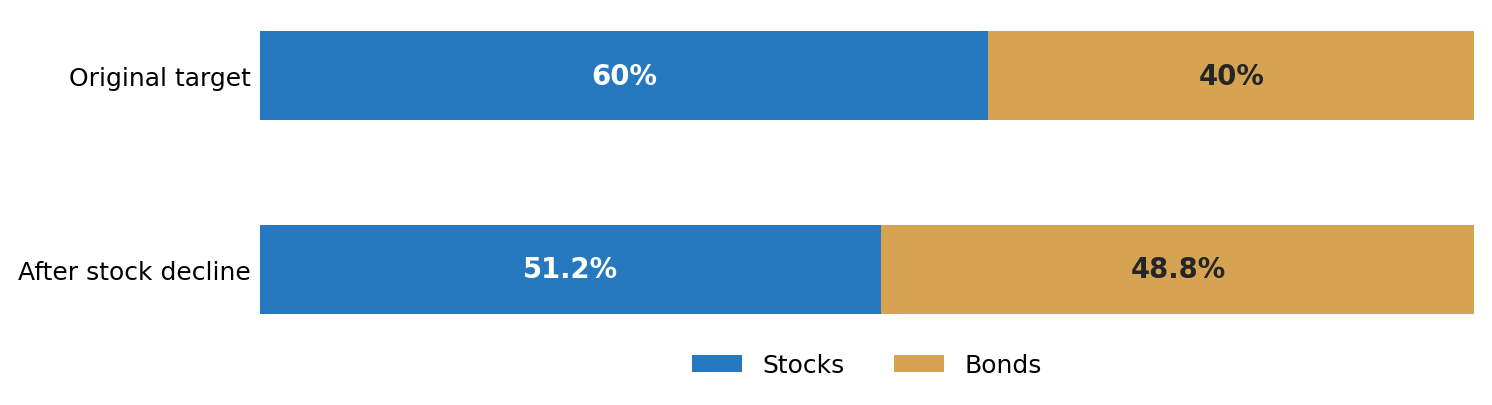
Assume a $100,000 portfolio begins with $60,000 in stocks and $40,000 in bonds. If stocks decline 30% and bond values remain unchanged, the portfolio would be worth $82,000.
| Asset | Before downturn | After downturn |
|---|---|---|
| Stocks | $60,000 | $42,000 |
| Bonds | $40,000 | $40,000 |
| Total | $100,000 | $82,000 |
Figure 2. Hypothetical change in portfolio allocation after a 30% stock decline, assuming stable bond values.
To restore a 60/40 target at the new $82,000 portfolio value, you would need approximately $49,200 in stocks and $32,800 in bonds. That might involve moving $7,200 from bonds to stocks, or directing new contributions toward stocks over time.
Before rebalancing, reconsider whether your original goals and risk tolerance are still appropriate. Also consider transaction costs and tax consequences.
Remember: Portfolio rebalancing is not about predicting the next market move. It is about keeping your portfolio risk aligned with your financial plan.
When stock prices keep falling, selling everything may feel like the safest option. But panic selling introduces another challenge: deciding when to return to the market. Successfully timing the market requires getting two difficult decisions right: when to sell before prices fall further, and when to buy again before prices recover. Even experienced investors struggle to predict both consistently.
If you sell after a major decline and wait too long to reinvest, you could miss some of the market’s strongest recovery days. That does not mean you should hold every investment forever. Selling may be reasonable if a company’s fundamentals deteriorate, your investment thesis is no longer valid, or your portfolio carries more risk than you can afford.
Instead of reacting emotionally, ask yourself:
The answers can help you make decisions based on your personal circumstances rather than short-term market movements. A well-defined investment plan provides valuable direction during periods of uncertainty.
Stock market crashes are an unavoidable part of investing. No one can predict exactly when the next downturn will begin, how severe it will be, or how long recovery will take. While you cannot control market movements, you can control how you prepare and respond. Understanding corrections, matching investments to your time horizon, maintaining an emergency fund, and rebalancing your portfolio can help you navigate uncertain markets.
There is no single strategy that works for every investor. What makes sense for someone investing for retirement 20 years from now may be inappropriate for someone planning to buy a house next year.
Ultimately, successful investing is not just about how much money you make when markets rise. It is also about how effectively you manage risk when markets fall. The goal is not to predict every crash. It is to build a financial strategy that can withstand one.
A falling market does not have to leave you without a plan. Dorian Trader can help you learn how options strategies may be used to hedge existing investments and explore potential opportunities when stock prices decline. Through practical options education, you can better understand protective puts, bearish strategies, and the risks and trade-offs involved—so you can make more informed decisions in volatile markets.
Explore Dorian Trader’s options trading education to learn how to prepare for market downturns, manage risk, and identify strategies that fit your financial goals.
1. Lorem ipsum dolor sit amet, consectetur adipiscing elit. Ut elit tellus, luctus nec ullamcorper mattis, pulvinar dapibus leo.
