


DORIAN TRADER​​

Weekly vs. Monthly Options: Which One Do You Choose?

When trading options, one of the first strategic decisions you must make is whether to trade weekly contracts or monthly contracts. They may look similar at first glance. Both are options. Both have expiration dates. Both can generate income or hedge risk.

But they behave very differently. And choosing the wrong one for your skill level can dramatically impact your consistency.

Let’s break it down.

Weekly Options

Weekly options typically expire every Friday, giving traders only 5 to 7 days until expiration. Because of this short time frame, several important differences emerge compared to monthly contracts. Weekly options experience much faster theta decay. Time works aggressively in your favor if you are selling premium, but it also works against you quickly if the trade moves the wrong way.

They also carry higher gamma risk. Small price movements in the underlying asset can cause large swings in option value. That makes weekly contracts more reactive and more volatile than monthly ones. In addition, the adjustment window is much smaller. With limited time remaining, traders must make decisions quickly. There is very little room for hesitation.

What this means in practice:

Faster potential losses  

Higher sensitivity to price movement   

More active trade management required   

Faster premium collection   
Weekly options are often better suited for experienced traders who understand volatility, position sizing, and adjustments. They reward precision and discipline, but they punish hesitation.

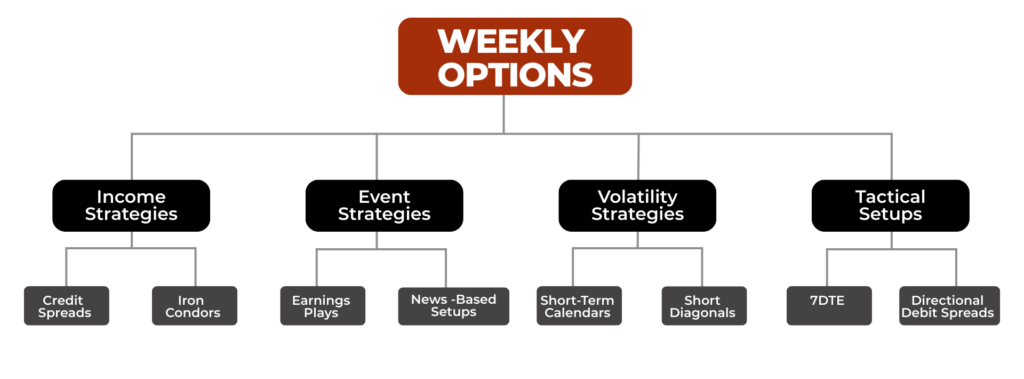
Strategies That Work Best With Weekly Options
Because weekly contracts operate within short cycles, certain strategies tend to perform better in this environment.
Monthly Options

Monthly options typically expire on the third Friday of each month and often have 30 to 45 days until expiration. That additional time changes the entire dynamic of the trade. Theta decay occurs more gradually. While time still works in favor of premium sellers, it does so at a slower and more manageable pace compared to weekly contracts. Gamma exposure is also lower relative to short-dated options. Price movements tend to have a smoother impact on option values, reducing sudden swings in P&L. Most importantly, monthly options provide a larger adjustment window. Traders have more flexibility to roll positions, manage risk, or allow probabilities to play out.

In practical terms:

Slower, more stable premium decay

Reduced sensitivity to sudden price spikes

Greater flexibility to adjust trades

Less need for constant monitoring
Monthly options are often a better starting point for beginners, part-time traders, and those still developing their adjustment skills. They reward patience and structure.

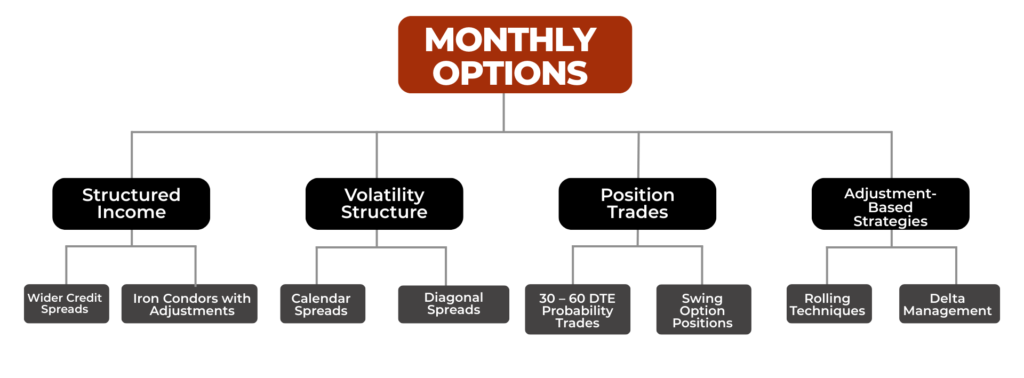
Strategies That Align Better With Monthly Options
With more time until expiration, monthly contracts allow traders to structure positions with greater flexibility and probability-based planning.
The Role of Volatility

Volatility can influence which duration makes more sense.

When implied volatility is elevated, short-duration trades may offer attractive premium opportunities due to rapid time decay.

When volatility is lower, longer-dated options can provide better flexibility and improved risk control. Understanding how volatility interacts with time to expiration is critical when choosing between weekly and monthly contracts.

Which Is Right for You?

Instead of asking which one is better, ask which one fits your current skill level and lifestyle.

Your Situation Weekly Options Monthly Options
Brand new to options Not recommended Better starting point
Learning how to adjust trades High pressure environment More time to manage risk
Full-time job outside trading Requires frequent monitoring More manageable
Experienced and disciplined Can offer strong income potential Still viable
Comfortable making fast decisions Suitable Also suitable

There is no universal answer. Only a strategic match between contract duration and trader capability.

Why a Trading Club Can Accelerate Your Learning ?

Learning options trading on your own can be challenging. Markets move quickly, strategies evolve, and without the right guidance it is easy to develop bad habits or misunderstand risk.

That is exactly why the Dorian Trader Trading Club exists.

Inside the Trading Club, traders learn how to approach the market with structure, probability, and discipline rather than guesswork.

Members gain access to:

Experienced traders who actively trade weekly options

Strategy breakdowns aligned with current market conditions

Live trade reviews and real market examples

A structured approach to probability, risk, and timing

Supportive accountability from a community of traders

Practical tools and frameworks you can apply immediately

Whether you are exploring weekly options or building longer-term strategies, learning alongside experienced traders can dramatically shorten the learning curve. If you are serious about improving your trading in 2026, you do not have to do it alone.

Join the Trading Club and learn alongside traders who are committed to mastering the craft.

Ready to Begin?

Start with structure, trade with confidence

Join the Dorian Trader Club

Start learning today and take control of your trading journey.
Click Here
Rules

1. Lorem ipsum dolor sit amet, consectetur adipiscing elit. Ut elit tellus, luctus nec ullamcorper mattis, pulvinar dapibus leo.