
Options trading does not always go exactly as planned. A stock can move faster than expected, an option can get close to expiration while your original idea still makes sense, or a covered call can suddenly move in the money after the stock rallies. When that happens, you do not always have to simply close the trade and walk away.
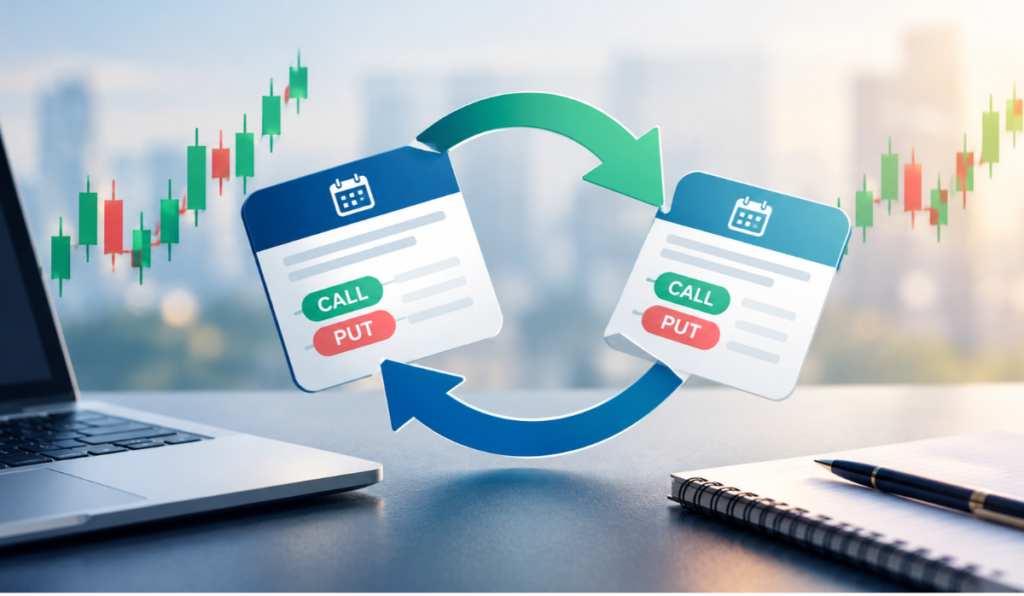
This is where rolling options can become a useful position-management technique.
Rolling an option means closing your current position and opening a new option position with a different expiration date, strike price, or both. In many trading platforms, these two actions can be entered as one combined order, but economically, you are still closing one trade and starting another.
The important thing to remember is that rolling does not magically remove a losing position or eliminate risk. Instead, it gives you an opportunity to change the terms of the trade and give the position more time or a different strike.
Let’s take a closer look at how rolling works, why traders use it, and what you should consider before deciding to roll.
Think of rolling as changing the expiration date or strike price of an option position instead of simply closing it and walking away.
For example, suppose you sold a cash-secured put on a stock with a $50 strike price that expires this Friday. As expiration approaches, the stock moves lower and the option is now in danger of being assigned.
Instead of allowing the option to expire or closing the position completely, you could:
✔ Buy back the current $50 put to close it.
✔ Sell a new put with a later expiration date.
✔ Keep the same $50 strike or choose a different strike.
✔ Receive a net credit or pay a net debit, depending on the prices of the two options.
That entire process is called rolling the option.
The new position is not technically the same trade continuing forever. The old position has been closed, and a new position has been opened. This distinction is important because a new premium collected from the roll should not be confused with recovering a loss from the original trade.
There are several reasons a trader might consider rolling an option, but most of them come down to one simple idea: the trader wants to adjust the position instead of closing it immediately.
Common reasons include:
✔ Buying more time when the original trade idea has not played out yet.
✔ Collecting additional premium from a new option position.
✔ Moving the strike price to better match the current stock price.
✔ Reducing the chance of assignment on a short option.
✔ Giving a covered call more room after the underlying stock moves higher.
✔ Adjusting a position that has moved against the trader while maintaining exposure to the underlying stock.
For example, imagine you sold a put because you were comfortable potentially owning the stock at $50. The stock drops to $48, and expiration is approaching. You still like the stock and would be comfortable owning it, but you would prefer a lower effective entry price.
One possible adjustment is to close the $50 put and open a new put at a lower strike with a later expiration. You have changed the trade rather than simply hoping that the stock suddenly reverses before expiration.
Rolling can involve changing the expiration date, the strike price, or both.
A roll out means moving the option to a later expiration while keeping the strike price the same.
For example:
✔ Current position: $50 put expiring this Friday
✔ New position: $50 put expiring next month
The strike stays the same, but you give the trade more time. Traders may use a roll out when they still like the original setup but do not want the position to expire yet. A roll out can also generate a net credit if the premium collected from the new option is greater than the cost of closing the current position.
A roll up means moving to a higher strike price. This can be particularly relevant for covered calls.
For example:
✔ Current covered call: $100 strike
✔ Stock price: $105
✔ New covered call: $110 strike with a later expiration
By moving the strike higher, the trader gives the stock more room to rise before the call reaches the strike price. The trade-off is that changing the strike may change the amount of premium collected and the overall risk/reward profile
A roll down means moving to a lower strike price. This can be useful when managing short puts or other positions where the trader wants to move the strike closer to a lower stock price
For example:
✔ Current put: $50 strike
✔ Stock has fallen to $47
✔ New put: $45 strike with a later expiration
The new position gives the trader a lower strike, but it also extends the amount of time the trade remains open.
You can also change both the expiration date and strike price at the same time.
For example:
✔ Current covered call: $100 strike, expiring this week
✔ New covered call: $110 strike, expiring next month
This is a roll out and up. For a put, you might move from a $50 strike expiring this week to a $45 strike expiring next month. That would be a roll out and down. This type of roll gives you more flexibility because you are adjusting both the price level and the amount of time remaining.
Rolling is just one way to adjust an options position. If you want to learn more about how to manage trades when market conditions change, check out The Ultimate Options Adjustment Playbook.
The course covers practical adjustment techniques, including Roll Up, Roll Away, Roll Out, and adjustments for popular options strategies
One of the most important things to understand about rolling is whether the transaction produces a net credit or a net debit. Suppose you need to buy back your existing option for $1.00 and you can sell the new option for $1.50.
The calculation is: $1.50 − $1.00 = $0.50 net credit
For one standard options contract, that would equal $50 before fees and other transaction costs. You received money for making the adjustment. But the opposite can happen too.
If you pay $2.00 to close the old position and receive only $1.50 for the new position: $1.50 − $2.00 = −$0.50 net debit
You would pay $50 to make the adjustment. Neither outcome automatically makes a roll good or bad. The more important question is what you are getting in exchange for the additional time and risk.
Rolling can be worth considering when your original market view is still reasonable, but the current expiration or strike no longer fits the situation.
For example, you might consider a roll when:
✔ The stock moved temporarily against your position.
✔ You still want exposure to the underlying stock.
✔ You need additional time for your original thesis to play out.
✔ A covered call is approaching the strike and you want to adjust the strike higher.
✔ A short put is approaching expiration and you would prefer a different strike.
✔ The new position offers enough premium to justify the additional time and risk.
One useful question to ask is: “If I did not already own this position, would I open the new position today?” This can help separate a genuine trade adjustment from simply trying to avoid realizing a loss.
Rolling can be useful, but it is not a way to make a losing trade disappear. Every time you roll, you are giving the position more time to develop. That can create another opportunity for the trade to work, but it also creates more time for the stock to move against you.
Be careful when:
✔ You are rolling only because you do not want to realize a loss.
✔ You repeatedly roll the same position without reassessing the original thesis.
✔ The new trade requires a large debit.
✔ The stock has fundamentally moved outside the conditions that made you enter the trade.
✔ The new position is something you would not normally open on its own.
✔ The additional premium is small compared with the additional time and risk.
This is one of the biggest misconceptions about rolling: you are not erasing the past trade. You are closing the old position and opening another one. That means the new position should make sense by itself.
Sometimes the simplest decision is also the best one: close the position. If the reason you entered the trade is no longer valid, there may be little reason to keep extending the position just because you can collect another small premium.
On the other hand, if your original thesis is still intact and the market has simply moved in a way that gives you an opportunity to adjust the expiration or strike, rolling can provide another way to manage the position. The key is to think about the new trade, not just the old one.
Ask yourself:
✔ What is my new strike?
✔ What is my new expiration?
✔ How much additional premium am I collecting?
✔ Am I paying a debit?
✔ How much additional capital is tied up?
✔ What happens if the stock continues moving against me?
✔ Would I be comfortable opening this new position today?
These questions can help you look at rolling as a deliberate trading decision rather than an automatic reaction.
Rolling options can be a useful way to adjust an options position when the market does not move exactly as expected, giving traders the flexibility to change the expiration date, strike price, or both while continuing to manage the trade. However, rolling should never be viewed as a way to make a loss disappear or avoid making a difficult trading decision. Every roll creates a new position with its own potential reward, risk, and time commitment, so the most important question is whether the new trade still makes sense based on the current market conditions. Before rolling, take a step back, look at the new strike, expiration, premium, and risk, and ask yourself whether you would be comfortable opening that position today. When you approach rolling this way, it becomes more than simply extending a trade—it becomes a deliberate tool for managing your options strategy.
1. Lorem ipsum dolor sit amet, consectetur adipiscing elit. Ut elit tellus, luctus nec ullamcorper mattis, pulvinar dapibus leo.