
Individual investors, especially options trading beginners, often discover that the hardest financial challenges aren’t technical, they’re emotional: impulsive entries, fear after losses, overconfidence after wins, and constant second-guessing when markets swing.

When the money mindset is shaky, even a solid plan gets derailed because decisions start serving stress instead of purpose. A healthier money relationship creates calmer, clearer choices around spending, saving, risk, and time horizons. The payoff is stronger financial well-being built on consistency rather than adrenaline.
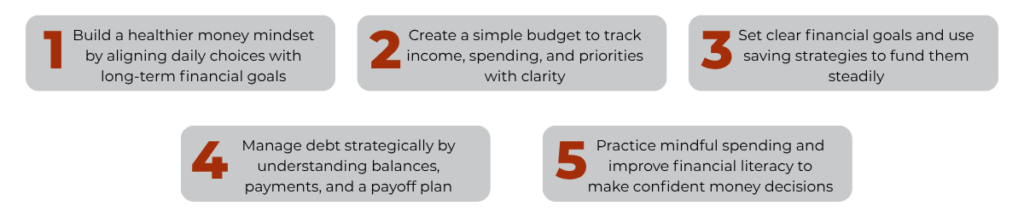
Here’s how to move from intention to action.
This process helps you get control of cash flow, reduce financial stress, and build the consistency that good investing requires. For options traders, a healthier money mindset is also risk management, because clear limits and steady savings reduce the urge to overtrade or “make it back” after a loss.
Step 1: Map your baseline budget
Start by listing your monthly take-home income, fixed bills, and flexible spending, then assign every dollar a job before the month begins. Keep it simple with 3 buckets: needs, goals, and lifestyle. A clear budget gives you a defined amount that is truly available for investing without tapping bill money.
Step 2: Set short-term and long-term goals
Choose one short-term goal for the next 30 to 90 days like building a $1,000 buffer and one long-term goal like funding retirement or a future home down payment. Add a target number and deadline so you can calculate a monthly amount. Goals turn “I should save” into a plan that supports patient, selective options trades.
Step 3: Automate regular saving first
Set up an automatic transfer on payday into an emergency fund, then into a separate “investing” account once the emergency fund is established. Start with a small percentage you can keep doing, then increase it after two to three pay cycles. Automation builds consistency and reduces reliance on willpower when markets get noisy.
Step 4: Use a simple debt reduction technique
Pick one method and stick with it: pay extra toward the highest-interest debt first, or knock out the smallest balance first for momentum. Call lenders to request a lower rate or explore consolidation only if the total cost decreases. Lower debt payments free up monthly cash that can fund education and a disciplined trading plan.
Step 5: Practice mindful spending and upgrade your education
Before any nonessential purchase, pause and ask whether it supports your goals or steals future flexibility, then track the answer for a week to spot patterns. Build your skill set with one focused lesson per week.
Small, steady choices add up to a calmer plan and cleaner decisions when you trade.
Keep the momentum going with these quick rituals.
Habits are what protect your plan when motivation dips and markets get loud. For individual investors learning profitable options trading, these routines build discipline around cash, risk limits, and ongoing education so decisions stay calm and repeatable.
1. Weekly Money Reset
What it is: Revisit your goals and weekly budget in 10 minutes.
How often: Weekly
Why it helps: You start the week with clarity on what is available to invest.
2. Two-Account Guardrail
What it is: Keep bills and trading cash in separate accounts.
How often: Always
Why it helps: It prevents “borrowing” from necessities after a losing streak.
3. Five-Minute Statement Scan
What it is: Review your bank statements and flag surprises.
How often: Weekly
Why it helps: Fast awareness stops leaks before they become debt
4. Pre-Trade Checklist Pause
What it is: Confirm thesis, max loss, and exit plan before entry.
How often: Every trade
Why it helps: It reduces impulse trades and revenge trading.
5. One Lesson, One Note
What it is: Study one concept and write one actionable rule.
How often: Weekly
Why it helps: Small learning compounds into better trade selection.
Pick one habit, make it easy, and fit it to your family’s rhythm.
Quick answers to keep your plan simple and steady.
Q: How can I create a manageable budget that reduces financial stress?
A: Start with a “baseline” budget that only tracks 4 categories: bills, debt minimums, essentials, and investing. Use one checking account to run the plan so you can track, spend, and save money with less guesswork. If you use Excel, freeze the header row, widen columns, then save a clean copy as a PDF. You can utilize this Excel to PDF tool.
Q: What are effective ways to set realistic financial goals to avoid feeling overwhelmed?
A: Pick one goal per time frame: 30 days, 90 days, and 12 months. Make each goal measurable and small enough to win weekly, like paying $50 extra toward a balance or saving one extra day of expenses. Put the target on autopay so progress happens without constant decision-making.
Q: How do I break the cycle of impulsive spending and practice mindful money habits?
A: Add a 24-hour pause for non-essentials and keep a short “replacement list” of free rewards like a walk or a library audiobook. Reduce temptation by removing stored card details and moving discretionary cash to a separate debit-only account. If you slip, record it without shame and set one rule for next time.
Q: What strategies can help me overcome negative beliefs about money that keep me stuck?
A: Treat money thoughts like hypotheses, not facts, and rewrite one belief into a testable statement such as “I can improve with a simple system.” Track evidence weekly, even tiny wins like fewer overdrafts or a smaller credit balance. If debt feels heavy, focus on one payoff method, either highest-interest first or smallest balance first, and stick to it for 90 days.
Q: How can I manage my money wisely when starting to invest in complex options trading?
A: Decide your “tuition budget” up front, a small amount you can afford to lose while learning, and keep it separate from bill money. Use defined-risk positions, pre-set max loss, and size trades so one mistake cannot derail your month. Build your confidence by journaling every trade in plain language, then updating your Excel tracker and exporting a PDF for accountability.
Keep it simple, keep it visible, and let consistency do the heavy lifting.
It’s easy to feel pulled between wanting better results and feeling unsure where to start, especially when markets and bills compete for attention. The path forward is a positive money mindset paired with simple, repeatable systems that keep emotions from driving decisions. Over time, that creates money management confidence, clearer choices, and real financial empowerment through steady progress. Small, consistent actions turn money stress into control. Choose one next action today, update your Excel budget, save a clean PDF snapshot, and set one date to review it, then let that single win renew personal finance motivation and strengthen your commitment to financial goals. This matters because stability and resilience come from habits you can rely on, even when life gets noisy.
Building a healthier money mindset becomes easier when you learn alongside a disciplined trading community. If you’re ready to strengthen your financial habits, improve your risk management, and develop smarter options trading strategies, consider joining the Dorian Trader Club. It’s a space where traders grow together through structured education, weekly insights, and practical support designed to help you trade with more confidence and consistency.
1. Lorem ipsum dolor sit amet, consectetur adipiscing elit. Ut elit tellus, luctus nec ullamcorper mattis, pulvinar dapibus leo.