

DORIAN TRADER​​

Embedded Risk Management in Options Trading: The Hidden Framework Behind Smarter Trades

Owanzer Stafford, Dorian Trader Club Member

Risk management is often treated like a backup plan. I see it differently. In our trading community, risk management is not something we add after the trade is on – it is built into the trade from the beginning.

That distinction matters.

Embedded Risk Management

When traders struggle, it is rarely because they do not know how to place a trade. More often, it is because they do not understand how risk is already shaping the outcome before the first order is sent. The real edge is not simply finding premium. It is knowing how to structure trades so that risk is reduced, defined, and managed at multiple levels.

That is what I call embedded risk management.

What Is Embedded Risk Management?

Embedded risk management is the collection of decisions made at trade entry and during management that naturally reduce exposure without relying on hope, prediction, or perfect timing.

In plain English, it means the trade itself contains risk controls.

Instead of asking, “What do I do if this goes wrong?” only after the market moves against us, we ask better questions upfront:

  What product am I trading?

   How volatile is it?

   How far are my strikes from the money?

   How much time am I giving the trade?

   Where will I take profits?

   Where will I cut losses?

   Do I need a hedge?
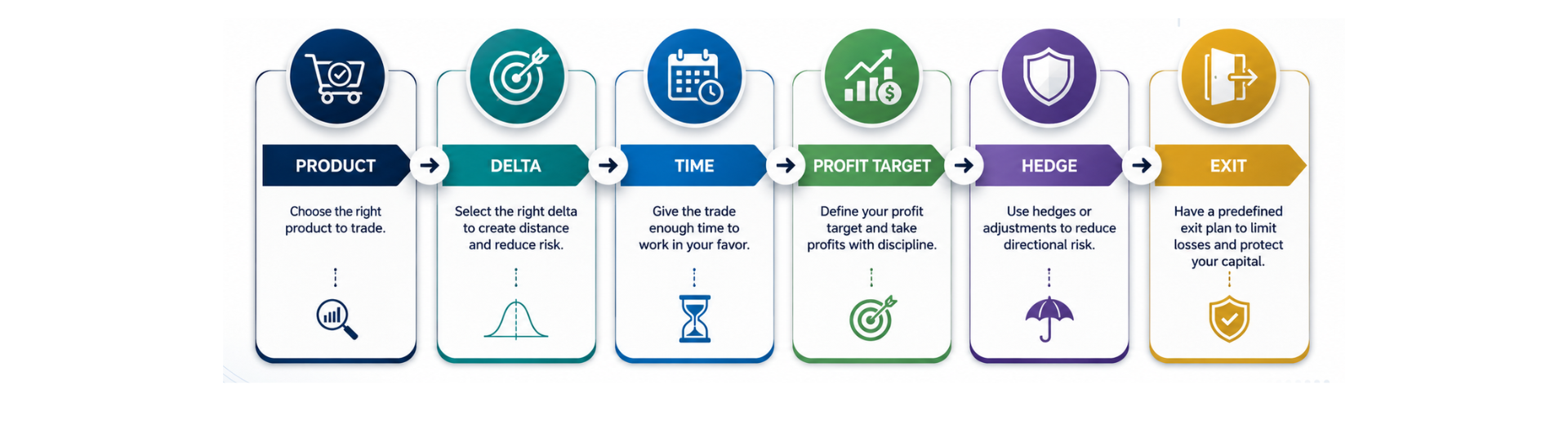
These are not minor details. They are the framework.

Why We Often Prefer Indices Over Single Stocks

One of the clearest examples of embedded risk management is the use of index-based products.

Indices can still move sharply, and there are no guarantees in any market. But compared with individual stocks, they typically reduce exposure to single-company events such as earnings surprises, analyst downgrades, executive headlines, and company-specific gaps.

That matters because a basket of stocks behaves differently from one stock.

When I trade indices, I am often choosing:

  Broader diversification

  Less single-stock event risk

  More stable structure for premium-selling strategies
This does not eliminate risk. It simply changes the type of risk I am taking, and usually in a more manageable way.

Delta Selection Is Risk Management

Many traders think delta is only about probability or option sensitivity. It is also a risk management tool. When I choose strikes with lower delta, I am intentionally placing the short strikes farther away from current price. That creates a buffer between the market and my exposure. Why does that matter?

Because the farther a short strike is from the money, the less likely it is to be immediately threatened. That gives the trade more room to work and reduces the probability of constant defensive adjustments. In that sense, delta selection is embedded risk management. I am not just selecting premium. I am selecting distance, probability, and breathing room.

Time in the Trade Matters

Another major form of embedded risk management is duration

Longer-dated trades often give the market more time to settle, mean revert, or simply stay within a range. Shorter-dated trades can work very well, but they also expose traders more quickly to sharp moves, gamma risk, and emotional decision-making.

This is one reason many structured income strategies benefit from allowing enough time for the thesis to develop.

More time does not guarantee success. It does, however, reduce the pressure that comes from needing the market to behave immediately.

Profit Targets Are Also a Defense Mechanism

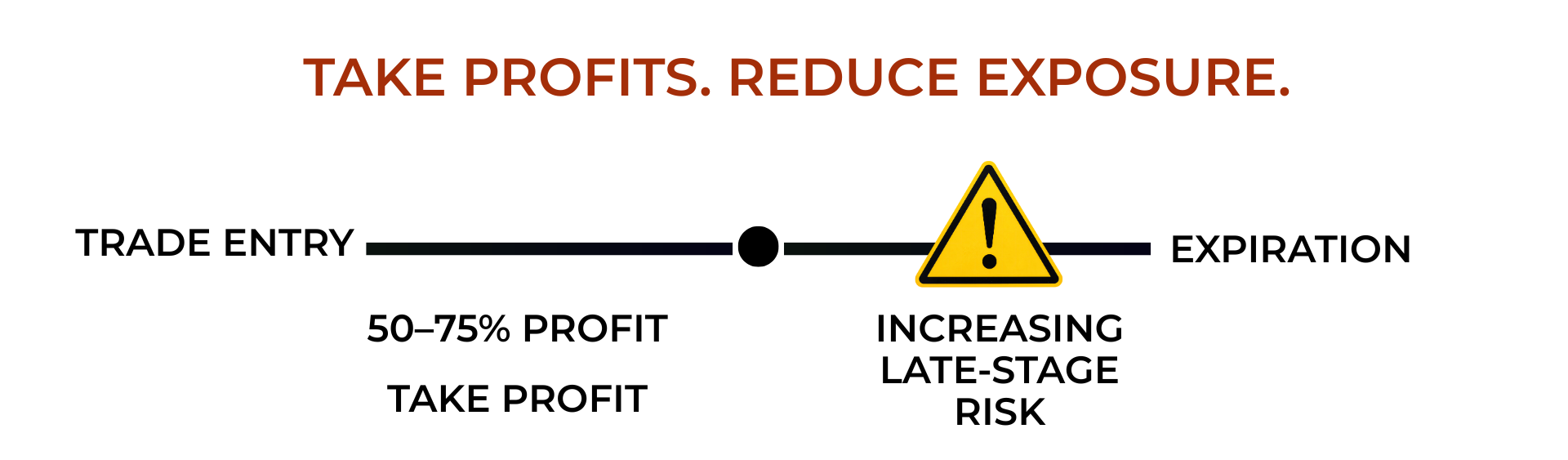
Taking profits at 50% to 75% is not just about discipline. It is a direct form of risk management.

As expiration gets closer, options can become more sensitive to price movement. A trade that looked safe earlier can become unstable late in the cycle. By taking profits before expiration, I reduce exposure to that late-stage risk.

This is especially important for premium sellers. If I have already captured a meaningful portion of the available profit, holding for the final few dollars may not justify the additional exposure. That is not fear. That is trade efficiency.

Hedging and Adjustments Should Have a Purpose

A hedge is not there to make a bad trade perfect. It is there to help reduce directional risk, create flexibility, and allow for more orderly decision-making.

Sometimes that means buying protection. Sometimes it means adjusting a spread. Sometimes it means reducing position size instead of forcing a complex repair.

The key is that every hedge should answer a simple question: What risk is this actually reducing?

If I cannot answer that clearly, the hedge may just be extra cost.

Good risk management is not about doing more. It is about doing what is necessary, on purpose.

Predefined Exits Keep Small Problems from Becoming Large Ones

Eventually, some trades will fail. That is part of trading.

This is why predefined exits matter. A multiple-of-credit stop, a hard risk threshold, or a structured adjustment plan can prevent one losing trade from doing outsized damage to an account. The goal is not to avoid every loss. That is impossible. The goal is to make sure losses stay survivable. Consistency in trading does not come from being right all the time. It comes from controlling what happens when you are wrong.

The Bigger Lesson

What I want traders to understand is this: risk management is not separate from strategy. It is the strategy. The products we choose, the deltas we sell, the time we allow, the profit targets we set, the hedges we use, and the exits we honor all work together. That is the hidden structure behind experienced trading.

Beginners need this because it creates discipline. Experienced traders need it because it preserves capital. Everyone needs it because markets do not reward carelessness for long.

If you want to learn how to apply embedded risk management in real-world options trading – not just in theory, but in live market context – the Dorian Trader Club is where that work happens.

Inside the club, we focus on structured strategies, trade management, risk-aware decision-making, and the kind of process that can help traders pursue income generation and account growth with greater clarity and consistency. There are no guarantees, and we do not sell fantasy. What we do offer is education, community, and a practical framework built for traders who want to improve.

Join the Dorian Trader membership club today and learn how to trade with a process, manage risk with intention, and grow inside a serious trading community.

Rules

1. Lorem ipsum dolor sit amet, consectetur adipiscing elit. Ut elit tellus, luctus nec ullamcorper mattis, pulvinar dapibus leo.
