


There was a time when earning six figures felt like a clear signal that you had made it, a moment where financial pressure eased and life became more predictable. Back then, reaching that level of income was often enough to support a truly comfortable living standard, but today that same milestone doesn’t seem to carry the same weight as it once did, and many people are starting to quietly question why something that once felt like success now feels merely average.
What’s changed is not just perception, but the reality of the financial environment itself, where the cost of everyday living has steadily increased to the point that even a strong income can feel stretched, especially in major cities where housing, transportation, and basic necessities have all moved in the same direction—up.
The concept of living comfortably has evolved in ways that are easy to overlook, because it is no longer defined by simply paying bills on time or avoiding debt, but instead includes a broader expectation of stability and quality of life, such as having a safe and convenient place to live, reliable transportation, the ability to socialize without financial stress, and enough margin to consistently save for the future, all of which together create a standard that is significantly more expensive than it used to be.
American families today are facing a convergence of economic pressures that is quietly reshaping what it actually means to live comfortably, as years of elevated inflation have pushed the cost of essentials such as housing, groceries, transportation, and healthcare to persistently high levels, while at the same time the rapid rise of technologies like artificial intelligence is introducing a new layer of uncertainty, even for traditionally stable white-collar jobs, making financial planning more complex than it used to be.
In this environment, the question is no longer just about getting by, but about understanding what level of income is required to maintain a truly comfortable lifestyle, which is why recent analyses based on the widely used 50/30/20 budgeting framework—allocating income across needs, wants, and savings—have attempted to quantify this threshold across different household types.
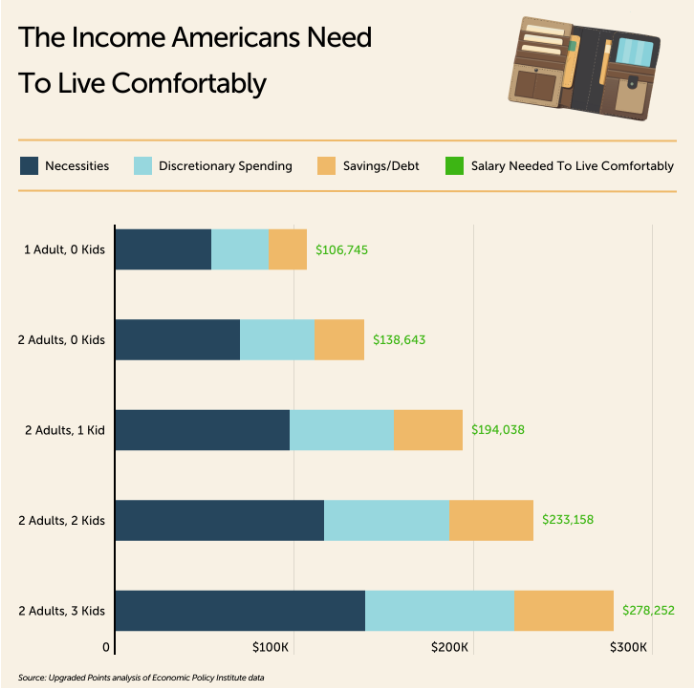
The chart below illustrates how quickly the required income scales depending on household size, offering a clearer picture of why so many individuals and families feel increasing financial pressure despite earning what would have once been considered a strong income.
Looking at the data more closely, the gap becomes hard to ignore, as a single adult now needs roughly $106,745 per year to live comfortably, while a household with two adults and no children may require around $138,643, and that figure rises to approximately $194,038 for a family with one child, eventually reaching as high as $278,252 for families with three children, which helps explain why so many people feel like they are earning more but progressing less at the same time.
So the real question becomes not just how much you need, but how you adapt in an environment where expenses continue to rise and financial pressure becomes the norm rather than the exception, and if you want to better understand how to navigate this shift and what strategies can help you stay ahead, you can watch the full breakdown here:
In a financial environment that feels increasingly difficult to navigate, it becomes even more important to shift focus away from what you cannot control and toward the levers that are still within your reach, because this is where meaningful progress actually happens over time.
Live within your means by aligning your spending with your actual income rather than an idealized lifestyle, especially when it comes to recurring expenses that can quietly compound over time.
Evaluate your levers by identifying the areas in your financial life that have the biggest impact, such as housing decisions, transportation choices, and income opportunities, and then making intentional adjustments where they matter most.
Bedazzle your basic life by finding ways to improve your quality of life without dramatically increasing your expenses, whether that means upgrading small daily experiences, optimizing routines, or creating enjoyment within your current financial structure instead of constantly chasing more.
In a rising cost environment, generating additional income becomes just as important as managing expenses, and one approach highlighted in the video is the covered call strategy, often described as a “landlord strategy” because it focuses on creating consistent income from assets you already own. At its core, this strategy involves holding stocks or ETFs and generating recurring income by selling options against them, making it attractive for those who want steady cash flow rather than relying on unpredictable large gains.
The main advantage is consistency, as it provides regular income and aligns with a long-term mindset of staying in the market while avoiding large losses; however, the trade-off is that it limits upside potential if the asset rises significantly and typically requires a certain level of capital to implement effectively.
Ultimately, it reflects a broader principle: in today’s financial environment, long-term comfort is less about chasing big wins and more about building steady, repeatable income over time.
If you want to explore how this strategy works in practice and how it can be applied step by step to generate consistent income, you can learn more here:
The reality is that $100K is no longer the benchmark it once was, not because the number itself has changed, but because the environment around it has become more demanding, and while this shift can feel discouraging, it also highlights the importance of adapting your financial strategy rather than relying on outdated expectations.
If you are serious about not just keeping up with rising costs but actually getting ahead of them, this is where surrounding yourself with the right people becomes a real advantage, and you can start by joining the Dorian Trader Club, where you’ll be part of a community of experienced traders who share practical strategies, real-world insights, and a disciplined approach designed to help you stay consistent, manage risk, and build income over time instead of chasing short-term wins.
In the end, financial comfort is not created by a single paycheck, but by the decisions you make repeatedly, the systems you build, and your ability to stay disciplined in an environment that is constantly changing.
1. Lorem ipsum dolor sit amet, consectetur adipiscing elit. Ut elit tellus, luctus nec ullamcorper mattis, pulvinar dapibus leo.