
When investors are deciding where to put their money, understanding stocks vs bonds is an important place to start. Stocks and bonds are two of the most common investment choices, but they work in very different ways and can respond differently to changes in the economy, inflation, and interest rates. Understanding these differences can help investors make more informed decisions about how each asset may fit into their portfolio.
That relationship becomes especially important when the Federal Reserve changes monetary policy. The Fed recently raised the target range for the federal funds rate by 25 basis points to 3.75%–4.00%, effective September 17, 2026. The decision was made as the Federal Reserve continued working toward price stability while economic activity remained solid. Understanding how higher interest rates move through the economy can help investors better understand what those changes may mean for stocks, bonds, and the broader market.
The simplest way to understand the difference between stocks and bonds is to think about what you own.
When you buy a stock, you are purchasing an ownership interest in a company. Your potential return comes primarily from the stock price increasing and, in some cases, dividends paid by the company. Stocks can provide significant long-term growth, but their prices can also fluctuate substantially as investors react to changes in corporate earnings, economic conditions, interest rates, and market expectations.
A bond works differently. When you buy a bond, you are essentially lending money to a government, municipality, or company. In return, the borrower generally agrees to make interest payments and return the principal at maturity. Because of this structure, bonds are often viewed as an income-producing investment, although they still carry risks, including interest-rate, credit, and inflation risk.
These differences become especially important when interest rates change because monetary policy can influence both the cost of borrowing and the return investors expect from different investments.
Interest rates and bond prices generally move in opposite directions.
Imagine you own a bond that pays a fixed interest rate of 3%. If newly issued bonds begin paying 4%, your existing 3% bond becomes less attractive to investors. If you wanted to sell that bond before maturity, its market price would generally need to fall to compensate the buyer for accepting a lower interest payment.
This is why rising interest rates can put pressure on the market prices of existing bonds.
At the same time, higher interest rates can create an opportunity for investors buying new bonds because newly issued bonds may offer higher yields than they did when rates were lower. So, while rising rates can hurt the market value of bonds already held in a portfolio, they can eventually provide investors with more attractive income opportunities.
The effect of higher interest rates does not stop with the bond market. Monetary policy can work through the broader economy by changing the cost of borrowing and the incentives to spend, save, and invest.
When the Federal Reserve follows a contractionary monetary policy, tighter financial conditions can push interest rates higher. Higher borrowing costs can discourage businesses from taking on new debt and can make some investment projects less attractive. Consumers may also become more cautious about borrowing for large purchases.
The basic economic relationship can be summarized as:
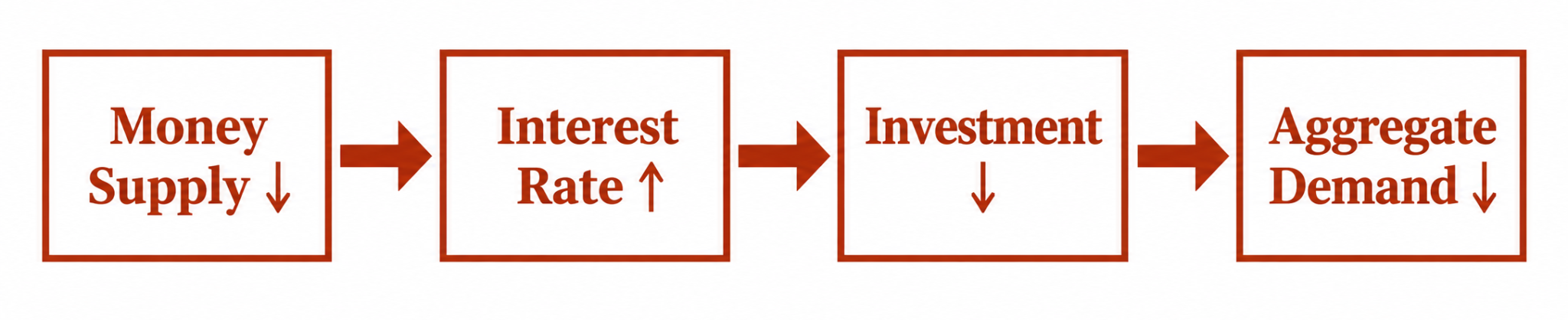
As investment and other interest-sensitive spending decline, aggregate demand can shift to the left. In the short run, that can put downward pressure on economic output and the price level.
The diagram below illustrates this relationship. In the interactive version, the policy-strength slider can be adjusted to see how a tighter monetary policy changes the interest rate, investment, aggregate demand, and the resulting equilibrium in the economy.
Adjust the policy type and strength to see how the money market and aggregate demand respond.
Illustration: Contractionary monetary policy — less money raises the interest rate, lowers investment, and shifts aggregate demand left.
When the federal funds target range moves to around 4%, the impact can spread throughout financial markets and the broader economy.
Higher short-term rates can increase borrowing costs for consumers and businesses while changing the return investors expect from different asset classes. For bonds, higher rates can put downward pressure on the prices of existing bonds. For stocks, the impact can be more complicated.
One reason is valuation. Higher interest rates can make future corporate earnings less valuable when those earnings are discounted back to their present value. This can be particularly important for growth-oriented companies whose valuations depend heavily on expectations of earnings many years into the future.
Higher borrowing costs can also affect companies directly. Businesses may delay expansion, reduce borrowing, or face higher interest expenses, which can potentially pressure future earnings.
However, a higher Fed funds rate does not automatically mean stocks will decline. Stock prices are influenced by many factors, including earnings growth, economic conditions, inflation, investor expectations, and the reason behind the Federal Reserve’s policy decision.
A federal funds rate around 4% represents a different interest-rate environment from the near-zero rates investors experienced during parts of the previous decade.
For bond investors, higher rates can provide an opportunity to earn more income from newly issued bonds. However, investors holding existing bonds should remember that their market prices can fluctuate as interest rates change.
The effect also depends on the maturity of the bond. Longer-term bonds generally have greater sensitivity to interest-rate changes than shorter-term bonds. This means two bond investments can respond very differently to the same Federal Reserve decision.
For investors building a diversified portfolio, the important question is therefore not simply whether rates are going up or down, but how the overall interest-rate environment affects the specific bonds they own.
It is common to think of stocks and bonds as natural opposites: when stocks fall, bonds should rise. History shows that this relationship is not always that simple.
There have been periods when both stocks and bonds declined at the same time. One example was 2022, when rising inflation and rapidly increasing interest rates created pressure across both asset classes.
This is an important reminder that diversification does not guarantee that every part of a portfolio will perform well at the same time. Instead, diversification is about owning investments with different characteristics and sources of risk so that a portfolio is not dependent on a single outcome.
Stocks and bonds can serve different roles within a portfolio, and understanding how each responds to interest rates can help investors make more informed decisions rather than assuming that one asset class will always move in the opposite direction of the other.
There is no universal answer because stocks and bonds are designed to serve different purposes.
Stocks are generally associated with long-term growth and have historically offered greater return potential over long periods, but that potential comes with greater price volatility and the possibility of significant losses during market downturns.
Bonds can provide income and may help reduce portfolio volatility compared with an all-stock portfolio, but they are not risk-free. Bond prices can decline when interest rates rise, and investors also face credit and inflation risks.
The right balance depends on an investor’s goals, time horizon, risk tolerance, and overall financial situation. For a long-term investor, the decision does not necessarily have to be an either-or choice. Stocks can provide growth potential while bonds can provide income and another source of diversification, and the appropriate combination can change as market conditions and an investor’s objectives change.
With the Federal Reserve’s target rate around 4%, investors have another reason to pay attention to the relationship between interest rates, stocks, and bonds.
Higher rates can create challenges for existing bond prices and can put pressure on certain stock valuations, but they can also create opportunities by offering higher yields on newly issued bonds. At the same time, neither stocks nor bonds should be viewed in isolation.
The more important question is how each investment fits into the overall portfolio and whether it supports the investor’s long-term objectives.
Understanding how monetary policy moves from the money market to interest rates, investment, aggregate demand, and financial markets can help investors better understand why a Federal Reserve decision can have effects far beyond the headline interest-rate number.
1. Lorem ipsum dolor sit amet, consectetur adipiscing elit. Ut elit tellus, luctus nec ullamcorper mattis, pulvinar dapibus leo.